St Andrews
2024
BLOCKCHAIN
Cultural Code


The official publication of the St Andrews Blockchain Society
foundAtion
Digital Art
Legal Affairs
Crypto Today
Financial analysis
ST ANDREWS, UK
www.ustablockchain.com
Contents
Introduction
5. Financial Analysis
Committee
36
02
Osian Guthrie
44
Lauren RAE
1. foundations
05
Finn Anderson
50
Zara WARD
James Maglione
08
Parker Caleshu
56
61
Hugo Okada
2. Digital Art
12
Jake Erlewine
15
William Cromartie
6. References
69
Society
3. Legal affairs
7. Committee Profiles
19
Piper Madden
74
Committee
21
Sean JEE
23
Piper Madden
Contributors
4. Crypto today
27
James maglione
32
Finn Anderson
The 2024 St Andrews Blockchain Society
@Ustablockchain
www.ustablockchain.com
01
I
N
T
R
O
We live in a culture that has cultivated the idea that the sceptical person is always smarter than the one who believes. — Dallas Willard
The burgeoning presence of digital assets has created a stark disparity throughout universities. Most remain firm cynics — unabated and uninterested in learning about Web3 — while some have recognized its capabilities in art, computer science, finance, law, and media.
The 2023/24 St Andrews Blockchain Society is excited to release the product of our first year of work. This publication caters to individuals of all skill levels — from those completely unfamiliar with Web3 topics, to confident enthusiasts, to sceptics.
We hope you find it enjoyable and informative, as we discuss the many areas of Web3, starting with the background of our society.
— STABS Committee
02
The St Andrews Blockchain Society
As an institution, the University of St Andrews does not offer any formal undergraduate education concerning Web3 or blockchain and offers limited exposure to financial technology and emerging asset classes. Students are already interested in digital assets but have not had any opportunities to explore the industry. Further, many have heard of cryptocurrencies and blockchain, yet do not understand what they are and how they can be used. Similarly, most perceptions of Web3 are unable to distinguish failed movements of the past from revolutionary underlying innovations.
Blockchain offers opportunities that go far beyond just trading cryptocurrencies, most of which are completely unknown to the average individual. Therefore, we have introduced the St Andrews Blockchain Society (STABS). This new club has intended to fulfill this unaddressed interest among students, bridging the gap between extracurriculars and academics, spanning all backgrounds and experience levels.
Blockchain is an incredibly large and complex field and is often overwhelming for newcomers. It is, however, multifaceted and interdisciplinary, offering opportunities to students with a variety of skill sets. We have structured STABS to reflect this, dividing the society into investing, development, and writing constituencies.
Through investing, students learn a variety of trading fundamentals and techniques, such as technical, fundamental, and sentimental analysis. While these methods are primarily applied to cryptocurrencies, they are also relevant to traditional investing practices. Members of this section have selected a protocol, developed an investment thesis, and presented their findings in the investment Financial Reports section of this publication.
The development section houses tremendous opportunities for computer science students, enabling them to develop their chosen coding skills. This team focuses on semester-long projects, the first of which was the construction of the STABS website. In the second half of the year, developers have had the freedom to select their own projects, such as building an algorithmic trading bot.
The writing section is a great place for those new to blockchain to learn, explore, and publish their own work. The primary goal of the section is to write concise articles to educate fellow students and the broader public on everything from blockchain fundamentals to regulatory filings, metaverse developments to derivatives innovations, or traditional finance applications to programming changes. Their final work is included within the first four sections of this publication.
Throughout the year, there have also been a variety of club-wide activities such as pub socials, networking events, resume workshops, and speaker events. Club members have been able to work in teams with students of similar backgrounds and skill sets, as well as make connections beyond just their specific constituency. They have learned the necessary fundamentals of Web3 and have had the freedom to follow their own lines of inquiry to further develop their passion and find where blockchain intersects with their studies and interests. This club has been an enjoyable way for students to learn about blockchain technologies, aiming to shift the narrative surrounding Web3 on campus and empower students to be informed and at the forefront of these cutting-edge developments.
03
1

Foundations
1

The Transformation of Money
BY Finn Anderson
05
There is a certain irony that the first central bank to issue currency notes is the first to consider abolishing the same medium.

The Sveriges Riksbank in Sweden has recognised that using cash is ostensibly outdated. Fumbling with your wallet, riffling for coins and notes before handing them to a person rather than a machine feels anachronistic. In a time when you can make a payment through your smartphone or with the tap of a credit card, it appears that cash is being replaced.
This shift in finance is a direct manifestation of other larger changes. In just a few years, the way people from both wealthier and poorer nations make payments has completely transformed. While already affecting households and governments alike, many individuals remain sceptical of the validity of these changes, propagating that cash is an undying and definitive form of money. Noticeably, their scepticism, like most debates, is predicated on their age, socioeconomic status, and technical savvy. I would also contend, however, that it is predicated on the reluctance from centralised institutions of the democratisation of finance.
For all the excitement about Bitcoin, its underlying technology is likely to persist longer than the
cryptocurrency itself. This is an important distinction that can be best explained by highlighting the flaws of traditional currencies. The core issue with conventional currencies is the trust required to make them work. The USD, for example, retains its value from a shared belief: a belief in the stability of the issuing government, the strength of the economy, and the confidence in the central bank's monetary policy. The USD derives its value from the belief of the populace — no longer a physical commodity, like gold.
This shared belief is trust. Central banks must be trusted to not devalue a currency. Commercial banks must be trusted with holding, transferring, and lending our money, while also safeguarding our privacy and security. Governments must be trusted to manage their own budgets responsibly to maintain economic stability.
Furthermore, these systems are based on metrics riddled with moral hazard issues. High overheads from commercial banks render micropayments infeasible and result in unfavourable exchange rates that make international transfers onerous. Furthermore, the
processing times involved in these transactions can hold individuals and businesses in prolonged abeyance. To reiterate, the entire traditional financial system is predicated on trust.
Blockchain, the underlying technology behind Bitcoin, employs cryptographic tools to eliminate the need for this trust. Cryptographic proofs intend to remove the intermediary, leaving the storage and transfer of money secure, simple, and democratised. These innovations are not without their major risks, however, leaving regulatory agencies to grapple with rapid changes and protect investors, while governments must institute policies that address their benefits and risks.
Nevertheless, blockchain protocols are able to maintain their lack of an intermediary through a concept called consensus mechanisms. Bitcoin, for example, uses a consensus mechanism called Proof of Work to validate transactions. For the network to function without a trusted third party, each block (quite literally a block of transactions) has to be validated by a network
participant, before being confirmed by the rest of the network.
Essentially, validators use computational brute force to solve a mathematical puzzle that can only be answered through guessing until a solution is found. The solution is then broadcasted and confirmed by other nodes (network participants) and then the block is added to the existing chain of blocks, forming a blockchain.
This process is simple, but not without its flaws. Primarily, it is costly, requiring warehouses of computational power. This fosters the misconception that all blockchain technology is inherently harmful to the environment. However, alternative consensus mechanisms have been developed to address this issue, lowering the computational power required to solve a puzzle to a single laptop. But that goes beyond this article.
Most people tend to stop here, assuming the extent of cryptocurrencies is simply the first layer, or “Layer 1”, of Bitcoin or Ethereum. This would be misguided, however, as other blockchains, like Ethereum, have implemented
10
06
Nevertheless, the unbacked currency has been unable to sustain a stable value; excessive transaction congestion has led to high transaction costs and unfulfilled orders; and with transparency, anonymity is not guaranteed. Rather than creating disillusionment with its failings, Bitcoin has instead spawned the continued innovation of other cryptocurrencies that aim to fix each of its issues.
The direction of money seems obscure but is continuously cleared by decentralised innovators. Their unending effort to democratise finance, regardless of economic or non-economic criteria, remains the strongest quality of blockchain technology during the ongoing transformation of money.
additional innovations, the most significant being smart contracts. Smart contracts are computer programs that fulfill the role of another trusted third party. Just like a signed written agreement, they cannot be altered once deployed and operate autonomously once the conditions of a contract are fulfilled.
Let's take an example; if Person A wishes to purchase 1 unit of a cryptocurrency from Person B, they could create a smart contract. This contract could take possession of Person A’s money and Person B’s cryptocurrency and execute a swap. If either party did not commit to their original obligations, the smart contract would initiate a refund — a process called atomicity. While sounding simple, the ingenuity here is that the integrity of this transaction — the assumed trust that it will be completed — is facilitated by the transparent, publicly available, and underlying blockchain. It would confirm the completion of the smart contract, the transfer of ownership, and the new account balances.
This hardly scratches the surface of the potential of blockchain technology. Through peer-to-peer connections facilitated by cryptographic hashing and consensus mechanisms, investors have gained access to a plethora of savings and credit products. International payments and remittances have become cheaper and quicker. Financial innovation has found a space to flourish, unabated by centralised institutions. Poorer households and entrepreneurs have gained access to a broader range of savings products and financing sources with less stringent collateral requirements than banks. Additionally, other stores of value can even act as collateral, such as cryptocurrencies or digital artwork. These possibilities are created through the combination of smart contracts implemented on computation engines like the Ethereum Virtual Machine (EVM).
Protocols use different standards of smart contracts to create projects like non-fungible tokens (NFTs), decentralized autonomous organizations (DAOs), and decentralized finance (DeFi) on the EVM. NFTs represent unique digital assets that, when created, deploy a smart contract; DAOs are governed by smart contracts that dictate their rules and decision-making processes; and DeFi protocols use smart contracts to conduct various financial functions, such as lending, transferring, borrowing, and yield farming. Despite their ingenuity, these innovations remain largely unbeknownst to most individuals.
Returning to Layer 1, Bitcoin by no means is without its faults. It was supposed to supply lower transaction costs, a reliable store of value, pseudonymity, and immunity from the issues of the traditional banking system following the global financial crisis.

07

Blockchain for dummies
BY James maglione
08
In the fall of 2008, a revolution was born.
In an anonymous cryptography mailing list post, a user named Satoshi Nakomoto stated “I’ve been working on a new electronic cash system that’s fully peer-to-peer, with no trusted third party.” Attached was a link to a 9-page proposal, titled “Bitcoin: A Peer-to-Peer Electronic Cash System.”
The timing of this post is key. The meltdown of the US economy seemed imminent. The Lehman Brothers bankruptcy had ushered the financial sector into turmoil. The international financial system seemed to be following as well. People were losing faith in traditional systems, desperate for a trustworthy alternative.
Bitcoin came to be seen as a medium of exchange, garnering widespread interest from retail and industry investors alike. Many, however, struggle to separate cryptocurrency from the underlying blockchain technology, which is essentially a digital ledger. Nakamoto, in a further blog post, argued that while this digital collection of transactions
would first be used for cryptocurrencies, it could expand across a variety of sectors in time.
A blockchain is a decentralized and distributed digital database (or ledger), accessible to a network of participants, that records and maintains a growing list of transactions. It is aptly named, as it links blocks of data into a digital chain. Blocks represent a bundle of transactions, record exact details such as the time of the transaction, the parties involved, and the nature of the asset being exchanged.
Blockchains are built on a few simple, yet powerful principles which make them so revolutionary and differentiate them from traditional financial systems.
Decentralization
In traditional systems, a single authority like a bank or a government has full control. Therefore, all transactions must be completed and approved by one of these institutions. Blockchain, however, has no central authority, but rather a network of participants, or nodes. To approve any transaction, a consensus must be reached between
these nodes. By taking the power away from a central body, individual users gain more autonomy and trust in the collective system. A key benefit is that without the need for a central authority to verify transactions, these processes can be executed much faster and with lower transaction fees.
Transparency
Every successful transaction is recorded onto the ledger, which is accessible to public users. While identities are hidden as pseudonyms, the details of every transaction are visible as soon as they have been made.
Immutability
Once a block has been created, it can't be deleted or altered. Each block of data is connected to the one before it, so as the chain grows in size it also grows in strength. As each transaction has been individually verified, there are no potential weak points.
Security
The immutability of blocks is due to the complex security measures in place (See Algorithmic Securitization). Existing data is protected by cryptographic hashing,
which takes a block’s data and uses an algorithm to encrypt it into a unique “hash function”. If any hash function were to be manipulated, the network would catch and reject this. Similarly, consensus mechanisms add a layer of security. To enter a point of data, consensus must be achieved between all nodes in the system. Consensus mechanisms often work on an incentive system, where users are rewarded for validating transactions. To falsify a data entry, a user would theoretically need to control 51% of the nodes in a network — an unobtainable target.
Applications
Blockchain has the potential to have transformative effects on all sectors and industries, particularly as the world continues to digitize. It is true, however, that blockchain has been somewhat limited to the financial sector thus far. Cryptocurrencies are the most prominent example. These are digital assets that, through blockchain platforms, can be exchanged or traded between individuals without an intermediary.
But the core principles of
10
09
blockchain, particularly its, security and transparency, extend its use drastically. Smart contracts for example, are digital contracts that automate all transactions on blockchain systems. These contracts consist of predetermined agreements that must be satisfied for a transaction to be verified and negate the need for lawyers or other central authorities. These contracts have the potential to thrive in industries like insurance and real estate where commodities are traditionally sold through intermediaries.
However, blockchain is also relevant to societal functions which rely upon transparency, security, and traceability. For instance, it can be used in supply chain management to monitor products or assets as they move from manufacturer to consumer. Similarly, the security of data entries and resistance to tampering make blockchain a strong platform to cast votes for elections.
Drawbacks
Like any major technological development, blockchain has drawbacks, particularly considering how early it is in its development. Many of these problems have been lessening over time, such as energy consumption, which can be dramatically decreased by using a Proof of Stake consensus mechanism compared to Proof of Work.
Interestingly, many of the key issues stem from the system’s strengths. For instance, while blockchain increases transparency, this can quickly start to infringe upon privacy rights. Similarly, decentralization creates some regulatory concerns. While blockchain is a very secure platform, the absence of a central body makes it harder to regulate transactions and detect and reprimand illegal activities.
Conclusion
In many ways, blockchain technology is still in its infancy. Even still, it has proven to be a transformative innovation. Blockchain has the potential to affect all industries in the way data is shared and transactions are made. It has already made a significant mark on society, as it has provoked discussion about the digital landscape and the power balance between central institutions and individuals. This, however, is just the beginning. While waves of hype have come and gone, currencies like Bitcoin and Ethereum have thrived for years and have proven they are here to stay. Similarly, the applications to industries like healthcare and real estate, or to basic processes like voting systems, contracts, and intellectual property, indicate that blockchain has the potential to expand far beyond the constraints of cryptocurrencies.


10
2
Digital Art
2

Botto, “Trickery Contagion,” 2021. GAN-Generated NFT. Credit: Botto
Previous Page: hex6c, “Verá Molnar 2/12,” 2021. Scaleable Vector NFT. Credit: OpenSea
QUASIMONDO: REALITY IN GAN-GENERATED ART
BY JAKE ERLEWINE
12
The artistic landscape found on platforms such as OpenSea and Binance NFT is of course radically different from that which one would find in the corridors of a fine art museum.

As if they were two different sections in an orchestra, digital artists rely on a set of media and implements that are altogether foreign to painters and sculptors, yet still can construct affecting images that contribute to a broader art historical discourse. However, just as physical art can achieve sensations that digital art cannot, the idiosyncratic questions of objecthood that GAN-generated art asks represent the niche that gives digital art its unique timbre in the contemporary artistic orchestra.
The German artist Quasimondo’s NFT art represents a unique venture in that it uses physical art as raw data in service of creating something intangible. Employing a Generative Adversarial Network architecture (GAN), in which a generative neural network is trained to produce pictures based on real-world images to ‘fool’ a discriminator network trained to discern what is real or AI-generated, the artist becomes engaged in a repetitive process which creates an artwork through the dilution of random data.
Take for example Quasimodo’s “Neural Delights #3” (fig. 1), created for Nick Knight’s 2020 exhibition “Fashion’s Digital Future.” The “Neural Delights” series reinterprets images from London Fashion Week catwalks through the lens of Hieronymous Bosch’s monumental Garden of Earthly Delights, impressing Bosch’s eye for imaginative detail and texture upon the figure of the model. The model becomes anonymized, as the GAN has erased all facial features, leaving behind an eerie, faceless figure.
Clad in dark green and navy – and seemingly made of Bosch’s foliage – I cannot help but be reminded of those prehistoric anthropomorphic stelae that represented the Neolithic self-awareness of humanity’s place in the larger world. Over time, these figures too, once recognizable by members of their community, have become faceless.

Mario Klingemann (Quasimondo), “Neural Delights #3,” 2020. GAN-Generated NFT. Credit: Mario Klingemann
10
13
What remains is a cache of innovation: the stela below (fig. 2), excavated in Ukraine, depicts a man with an axe, itself a product of copper metallurgy that was newly realized in the latter half of the fourth millennium BCE. It can be said, then, that the reason that these images are meaningful is that they are not depictions of figures, but rather depictions of progress.
Like the stela, the work of Quasimondo visually represents several innovations portraying not only the contemporary overlap of technology with fashion but a postmodern mixing of styles and temporalities. The inputs of Bosch’s palette and style alongside the imaging of the 21st-century model – when seen through the lens of the artist’s unique GAN architecture – appear incomprehensibly consonant with each other, as if each were around to influence the other in their lifetimes.
This cache of innovation is minted through something that is itself an innovation: being an NFT, the artwork becomes liquid, having an ease of transportation and transaction that even the smallest physical work lacks.
It is this status as an arena for depicting the social conditions of artistic production that cements the NFT’s status as not only art but an object: something that has been created by a machine that exists outside the realm of human perception yet is itself the culmination of the last fifty years of human artistic process. It is thus its inhumanity - the very same as that found within the stele - that allows it a view of human ingenuity from the outside, making generative art an unbiased historian of human achievement.
To conclude, when discussing art that so beautifully creates meaning out of white noise, it is impossible for me not to be reminded of a quote from Cormac McCarthy’s The Road: “When you’ve nothing else, construct ceremonies out of the air and breathe upon them.” While the quote serves primarily as instruction on how to create meaning in a meaningless world, it also can be interpreted through hindsight as a revelation of the true power of the NFT artist – the ability to turn nothing into something.

Anthropomorphic Stele excavated from Natalivka, Ukraine, c. 4500 BCE. Credit: A.C. Ambrosi
“IT is thus its inhumanity That allows it a view of human ingenuity from the outside, making Generative Art an unbiased historian of human achievement”
14
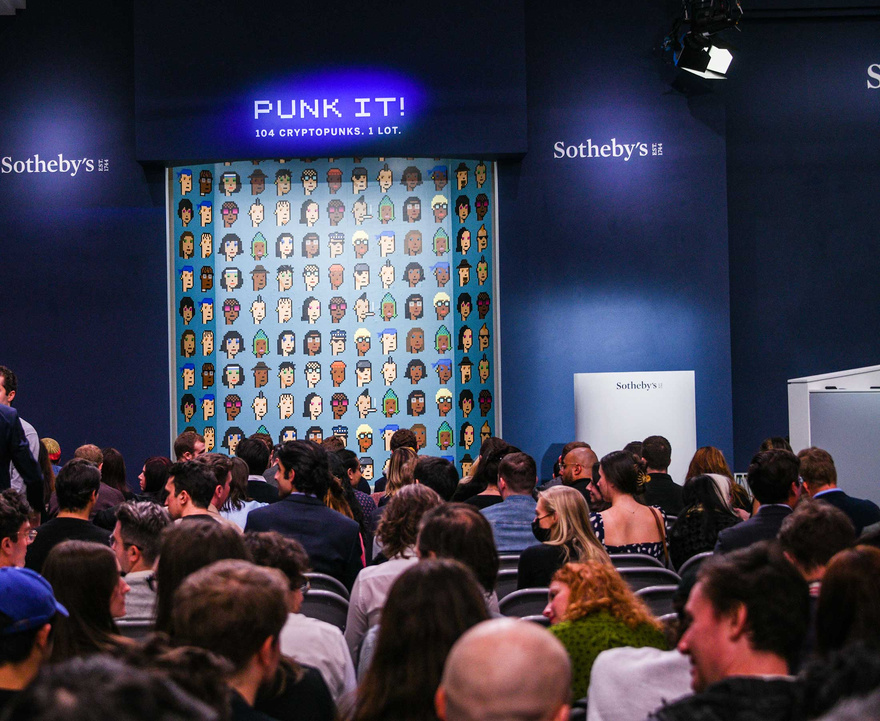
The view from the audience at the Sotheby’s “PUNK IT!” auction on February 23, 2022. This was the first physical auction at Sotheby’s devoted to NFTs. Credit: Sotheby’s.
Sotheby’s Metaverse: A Profile
BY William Cromartie
15
Sotheby’s, founded in 1774, is the world’s largest auction house by market share and operates a brand inextricably tied to the old guard of the art market.

Especially in the aftermath of its recently resolved legal clash with Russian billionaire Dimitry Rybolovlev, which concerned allegations against the auction house of art fraud, Sotheby’s is regarded as a beacon of consistency and expertise in a volatile and deregulated industry. It is thus unsurprising that, with the recent conversion of Sotheby’s Metaverse into a completely on-chain system, the company has sought to bring its expertise in the appraisal and selling of fine art into the world of digital art.
Since its launch in 2021, Sotheby’s has partnered with platforms such as Decentraland - a decentralized virtual marketplace that runs on Ethereum - to connect with prospective buyers who would not normally be found in a more traditional art auction setting. This, at its time, was a groundbreaking foray into a space that had heretofore been inaccessible to the fine art world.
However, this is not to say that Sotheby’s has not had to adapt its business practices to the blockchain. 2023 saw the introduction of the Dutch auction format - in which a lot is offered at an agreed-upon maximum price that is incrementally lowered until a bid is made - on Sotheby’s Metaverse. This inversion of the classic auction format should not be read as an abandonment of principle, but rather as another step forward in tying the physical auction world with the digital.
This system allows lots to be sold quickly and efficiently, as the auction would end with the first bid. In an artistic climate where NFTs are produced by the tens and hundreds, this offers a streamlined structure that benefits both auctioneer and consumer - look no further than the July 2023 auction of Vera Molnár’s Themes and Variations series, where 500 works were minted in under an hour for a gross total of 631 ETH ($1.2 million), for evidence of this.
The learning curve for the auction house culminated in an August 2023 expansion of Sotheby’s Metaverse presence, moving to a completely on-chain system run by Ethereum and Polygon.

Test mint from Verá Molnar, “Themes and Variations,” 2023. Generative NFT. Credit: Sotheby’s
Combined with the continued curation of the Metaverse’s artistic offerings - all of which are critically/art-historically informed and hand-picked by NFT experts - it shows a doubling down by Sotheby’s on its investment in the digital art landscape, and a streamlining of that investment to boot.
With the fully integrated system running P2P transactions on Ethereum and Polygon, digital auction fees will be greatly reduced while also allowing the Metaverse structure to handle a much higher volume of financial activity.
10
16
For a business that thrives on selling collections of lots that are usually sold over a short time period, this is advantageous. Intense curation has also allowed artists who would normally be restricted from participating in the art market to increase their exposure to consumers.
Osinachi, a Nigerian artist whose NFTs form a powerful statement about the obstacles that face the African diaspora, would for example have been hampered from selling his works traditionally given the restrictions that the Nigerian government currently has on its citizens’ international transactions. The Sotheby’s Metaverse therefore acts as a sort of ‘centralized decentralization’ that allows artists and collectors in similar situations to deal directly with each other without worrying about political concerns. In summary, Sotheby’s scaleup of its digital platform yields important benefits for its target audience, and its effect on the company’s bottom line has already been seen in recent auctions.
The expansion of auction houses into the metaverse, therefore, can be said to be a marriage of the physical and digital channels of the art market. Providing a unique yet useful platform for NFT artists and sellers alike, Sotheby’s Metaverse represents an example of impressing the expertise and structure found within the behemoth auction houses upon the volatile Wild West of the digital marketplace.

Still from Osinachi, “Take the Stares,” 2020. GIF. Credit: Sotheby’s
“This should not be read as an abandonment of principle, but rather as a step forward in tying the auction world with the digital.”
17
3

Legal
Affairs
3

march madness
BY Piper madden
19
March seems to be the time of year when Washington D.C. thinks about crypto.
This time last year, the Supreme Court of the United States was hearing its first-ever case related to the cryptocurrency industry — now, it has become a pattern. On February 28th (the eve of March), the justices heard oral arguments in Coinbase v. Suski, a case which, like its predecessor, was largely concerned with arbitration (for a deeper analysis of the case, Coinbase v. Bielski, see my article on page 23).[1] In this case, the question was whether the arbitrator or court should determine if a dispute should be a matter of arbitration, decision pending.
Meanwhile, lawsuits filed by the SEC against various cryptocurrency exchange platforms are rapidly filling the lower federal courts, and the cryptocurrency industry at large is on the defense. The disputes in these cases primarily revolve around the allegation that the firms have engaged in the sale of unregistered securities, which, if affirmed, could result in court orders limiting the practice of digital asset trading.[2] The legal battle is particularly heated in the Second Circuit (especially the Southern District of New York), where thus far the SEC has filed cases against Coinbase Inc. and Terraform — favorably gaining legal traction in both within the last six months.[3][4]

If the retaliatory lawsuit tactic is successful, we can certainly expect to see more March madness about crypto. And this time, it will address the substantial matter of whether the right to regulate crypto exchanges lies within the power of the SEC— something which will inevitably shape the future of this novel industry, for government regulation or legal latitude, for scrutiny or slack, along the way bringing to courtroom light more of the minutia of this industry’s dealings.[7]
As eventually happens to anything in its infancy stage, the honeymoon period of being unshackled by yet-to-exist legal precedent seems over. But until then, the question stands: how elusive might the cryptocurrency industry stay, and for just how much longer?
10
20

Cyberattacks and Illicit Transactions: A Call for Stronger Regulation
BY Sean Jee
21
The rise of crime driven through digitised means presents a multifaceted challenge to global security and financial stability.
From high-profile data breaches to the clandestine funding of extremist organizations, the intersection between cybercrime and illicit financial activity has become a pressing concern for governments, law enforcement agencies, and financial institutions alike.
In one instance, on March 14th, 2022, the UK Ministry of Defense and the British Army suspended their online recruiting service and careers page — owned and managed by Capita as part of their Recruiting Partnership Program — citing “technical issues.” Capita, a London-based professional services company, had fallen victim to one of many cyberattacks originating in Russia. It was an elaborate cyber-heist of the personal information of over 100 British Army recruits. This information was subsequently put on sale online. Given the assumed anonymity of digital currencies, it was listed for 1 Bitcoin, equivalent to $42,000 at the time.[1]
Another second, more recent, example involves the ongoing Israeli-Palestine conflict. Palestine's surprise attack was an intricate and
expensive military operation. Their sudden increase in combat readiness, as well as their acquisition of sophisticated technologies and armaments, had gone undetected by Mossad and Western intelligence agencies. But where did all this funding come from?
Leading up to the event as many as 150 known cryptocurrency accounts were associated with fundraising activities for Hamas’ Qassam brigades, averting the strict sanctions imposed by the US since its classification as a terrorist group by the US State Department in 1997.[2] Enabled by trading platforms such as Binance, Hamas continues to host virtual currency fundraisers through fictitious charities, despite efforts from the authorities to limit their inflow of capital. Clearly, cryptocurrencies served as a means to fund their activities, marking an omen for the pervasive security challenge to come.
Cryptocurrencies are attractive for their investment opportunities but also for their decentralisation and anonymity. However, it is the same decentralised, peer-to-peer nature of these
digital currencies that can offer a safe haven for criminal activities, far from the eyes of regulators and law enforcement agencies. From the perspective of the Russians among other non-state armed militias like Hamas, it is the perfect exploit to circumvent US sanctions and fund their militant campaigns.
According to the crypto analytics firm Chainalysis, it is estimated that sanction-related transaction volume has increased by over 152,844% since the Ukraine war, with the illicit transaction volume for 2023 being 0.34% (an increase from 0.24% in 2022) of all cryptocurrency transactions.[3][4] Superficially, this may seem to be a trivial amount, but that percentage translates to a whopping $24.2 billion. It is no surprise that the Department of Justice has created the National Cryptocurrency Enforcement Team to combat these illicit transactions.[5]
The escalating use of cryptocurrencies in cybercrimes, illustrated by incidents like the Capita infoleak scandal, exposes an urgent need for robust regulatory frameworks. While digital currencies offer alluring opportunities
for many industries, their misuse poses significant security and geopolitical challenges. Policymakers must strike a balance to ensure the security of their nations, while not infringing upon the financial freedoms and decentralisation offered by cryptocurrencies. Regulators worldwide are faced with a daunting task, requiring international collaboration, stringent yet adaptable regulations, and public awareness to legislate in these unchartered territories.

10
22

Coinbase in Court: A Legal Battle for Privacy
BY Piper madden
23
To what extent would you go to maintain a right to privacy?
To what extent would you go to maintain a right to privacy? For Coinbase, the “largest cryptocurrency exchange in the United States”, the answer has proven to be surprising.[1]
In March of 2023, the United States Supreme Court heard oral arguments in its first ever cryptocurrency-related case, Coinbase, Inc. v. Bielski. Shockingly, the lynchpin of the case didn’t involve trailblazing digital marketplace law or even interpreting cryptocurrency regulations, as one might expect. Rather, the question for the court was broadly one of arbitration.
Arbitration is a methodological alternative to litigation, its primary benefits being that it is confidential (i.e., private, unlike the public court system), it precludes consequent litigation, and it is relatively inexpensive. Perhaps also at play is the fact that “arbitrators are not subject to the [same] Federal Rules of Evidence” as courts, hinting at the privately low-key , unobtrusive nature of arbitration.[2]
As for Coinbase, it ironically raised its case in the
Supreme Court solely in hopes of avoiding more litigation — and bolstering its odds to arbitrate. But why?
Back in the fall of 2022, Coinbase had racked up a handful of lawsuits in districts across the U.S. from Georgia to California raised by investors and customers alike, including an investigation by the SEC. Many filed complaints alleged security concerns, in which hundreds of users claimed to have been denied access to their Coinbase accounts for up to months at a time. The complaint filed in one of these cases, Kattula v. Coinbase Glob., emphasized the inequity of lock-outs, citing “the extreme volatility of cryptocurrencies’ value – with freefalls of 40% within 24 hours not unheard of… lead[ing] to severe financial loss to account holders.”[3] If account holders couldn’t access their accounts, they couldn’t sell crypto assets at their own will or discretion. Users thus sought upwards of $5 million worth of damages in this case alone. Other class action cases raised concerns about fraudulent activity, misleading sales practice, and a New Jersey lawsuit
even accused Coinbase of “violating federal law by listing securities on its trading platform.”[4] Under tremendous litigious pressure, Coinbase hoped to sidestep a series of scandalous lawsuits that would plunge the cryptocurrency industry into even further disrepute. Instead, it began seeking from courts an alternative — arbitration.
The core of the upcoming thicket of legalities is: 1) timing, and 2) maintaining confidentiality. In the specific background of the SCOTUS case at hand, Coinbase v. Bielski, it is important to know that Coinbase had been previously denied motion for arbitration by two federal district courts — leaving the class-action lawsuits potentially active. In accordance with their rights under the Federal Arbitration Act, Coinbase immediately appealed the lower courts’ ruling to the 9th Circuit Court of Appeals, hoping for a different outcome. Namely, Coinbase again sought a motion to pursue the alternatively low-profile form of dispute resolution – arbitration.
What follows in the
Supreme Court’s case, Coinbase, Inc. v. Bielski, is a discussion of what occurs in the interim — whether district courts are allowed to proceed immediately with litigation considering their anti-arbitration rulings, while Coinbase awaits the final say on arbitrability from the 9th Circuit. If it rules in favor of arbitrability, the lower district court proceedings become void, raising the legal question of: why hold a potentially discardable trial rather than just wait? Timing here is key — a half-baked district trial could have multiple negative ramifications, as Coinbase is keenly aware. Its confidentiality, and thus, reputation, hinges on SCOTUS’ interpretation of Section 16(a) of the Federal Arbitration Act, (which dictates policies on stays in such scenarios.)
Given the common-sense application, it appears likely that Congress broadly intended a stay (i.e., halt) on district court proceedings while an appeal lingers, possibly for years, in circuit courts. This is the view Coinbase argues. Otherwise, if district courts don’t stay the trial, those benefits that petitioners seek in appealing for
10
24
arbitration would be lost — in such a view, courts could potentially carry out a full proceeding. This hypothetical trial would entirely defeat the point of seeking the privacy of arbitration.
In the hour-long oral argument, Neal Katyal, counsel for petitioner Coinbase, frequently cited a metaphor that sums it up. Katyal states that such a trial would require backtracking equivalent to ‘putting toothpaste back into its bottle’: in so many words, its effects are irreversible. The primary concern being that “confidentiality concerns…will get undone in the interim.”[5] Legally and practically, Coinbase’s argument to interpret 16(a) to compel district courts to stay proceedings awaiting interlocutory appeal was convincing.
For this, among other precedent-related reasoning, the Supreme Court ruled 5-4 in favor of petitioners — Coinbase — on June 23, 2023. Cryptocurrency had now officially made its debut in the sphere of elite American politics and, according to judicial headlines, it emerged victorious, winning a ruling that keeps them out of lower courts — for now. Could this SCOTUS ruling signal a shifting tide in American sentiment regarding blockchain, NFTs, and all other facets of the crypto revolution?
Not necessarily. In fact, the converse might just be true. To anyone who studies this case carefully, it seems less of a win than a gamble. What Coinbase has succeeded in doing in SCOTUS is nothing more than establishing trivial precedent that trial proceedings must be stayed in a very slim context relating to a subsection of interlocutory appeals. Hence, it is, on its surface, a seemingly nonessential case turning on federal civil procedure’s legal minutiae.
But at its heart, this ruling favors arbitrability and, more importantly, its associate — confidentiality. It's a ruling that favorably induces Coinbase to as little class action litigation as possible — for now. Still pending, the 9th Circuit might yet rule against arbitrability, in which case Coinbase would face the very trials it’s been so desperately avoiding.
As Justice Kavanaugh hinted in his majority opinion, Coinbase has gambled — at the cost of significant legal expenditure in the highest courts of America — to arbitrate.[6] Why go to such extremes to maintain what is, at the end of the day, a right to privacy? After all, the legal question was motivated by Coinbase’s goal of keeping things out of the courts, out of the hands of the public, and out of view. In other words, Coinbase, Inc. v. Bielski recounts an all-too-familiar story of the lengths a company will go to keep its
allegations out of the public eye. To conspirators, it raises suspicions as to what exactly might be hiding behind the company’s high stakes closed doors. And to crypto sceptics, it epitomizes the elusivity expected of an industry founded under a pseudonym, championing decentralization, and dealing in anonymous transactions.
So perhaps the better question for the court is: should the confidentiality afforded in arbitration even be an option for publicly accountable businesses like Coinbase? Or should a company willing to go to such lengths to keep mysterious records out of the public eye really be isolated from the proper scrutiny of America’s legal system? And what ripple effects will SCOTUS’ ruling have for customers? If users are allegedly being misled or wronged, is it right to resolve these multi-million-dollar disputes in a less rigorous evidentiary setting?
Many, including Bielski, would say an emphatic no. This case leaves many questions unresolved, and one can expect to see more legal challenges to the cryptocurrency exchange taking up court dockets in the future.
25
4
Crypto
Today
4

Humilation to Adaptation: Revisiting the 2022 ‘Crypto Bowl’
BY James maglione
27
This past year, the Super Bowl was viewed by 123 million people in the United States, with an additional 62.5 million viewers worldwide.
Many in this audience are not even remotely interested in the NFL, nor are they invested in the game itself. And, yet, they still watch every year.[1]
This is because the Super Bowl is about so much more than just football. It is, in essence, a spectacle — one that puts American pop culture, enterprise, and politics on display for all to see. A primary way it achieves this mainstream, all-encompassing appeal is through its advertisements. While ads are usually a disturbance for fans, they can be the main event for casual Super Bowl viewers. With their high production value, celebrity cameos, and cinematic qualities, these commercials can feel more like comedy skits or short films than advertisements.
As such, they provide companies with a massive opportunity to reach an eager and welcoming global audience of consumers. But the stakes are high. Corporations pour resources and talent into these projects (the average cost of a 30-second ad was $7 million in 2024), and risk failure and scrutiny on the biggest possible stage.[2] For most, the risk is worth the reward. Every year, the
biggest companies on earth line up for 30 seconds of the American public’s attention. There are many staples in Super Bowl advertising — like Budweiser and Pepsi — but the emergence of new brands can often signal growth in an industry.
The Crypto Bowl
In 2022, it was all about cryptocurrency. Four of the biggest exchanges of the time – FTX, Coinbase, Crypto.com, and eToro — all chose to splash the cash and advertise during the game. In total, blockchain companies spent over $50 million just to secure airtime at the event.[3] The commercials matched the grandeur of the event, filled to the brim with elaborate visuals, celebrity appearances, and bold messaging.
Crypto.com, for instance, employed Lebron James to shoot a 30-second ad, where the basketball star has a conversation with a CGI-rendered 18-year-old version of himself. In the commercial, young Lebron asks ‘Is the hype too much?’ The advertisement’s title, “Fortune Favors the Brave,” seems to answer this question. Coinbase, on the
other hand, took a completely unorthodox approach, buying up a full minute of airtime and filling it with a lone QR code floating around the screen. The QR code led to Coinbase’s website, where the exchange was offering $15 in Bitcoin to each user who signed up, and the chance to win $3 million in Bitcoin.
But no crypto ad was more provocative, or infamous, than FTX’s Super Bowl appearance. This ad situates FTX, and crypto more generally, at the end of a very long line of essential human innovations including, but not limited to; the wheel, the fork, the toilet, electricity, space exploration, and even democracy itself. At each turn, the star of the commercial – actor and comedian Larry David – is presented with the new invention, which he promptly and pompously dismisses. The ad ends with two simple, but extraordinarily telling title cards: “Don’t be like Larry” followed by “Don’t Miss Out On Crypto.”
The messaging in these different commercials was bluntly obvious — ignore the sceptics and invest while you can.
The fundamental strategies these commercials used to achieve this message — particularly the Coinbase and FTX ads — were not entirely new. Celebrity cameos have long been a go-to for crypto companies to generate notoriety and legitimacy amongst the general public. Crypto.com's “Fortune Favors the Brave” campaign began well before the Super Bowl. In 2021, Matt Damon appeared in a commercial for the campaign where he similarly situated cryptocurrencies within a history of exploration and innovation. NFL star Tom Brady starred in three commercials for FTX, two before the Super Bowl and one in September of 2022.
Further, the marketing strategies were hardly limited to just commercials — although there has always been a heavy concentration on sports marketing. A study from Pew Research found that crypto investing is highest among males aged 18-29 (42% of this demographic have invested as of 2022), hence the industry's efforts to appeal to the male-saturated sports entertainment industry.[4] Beyond the slew of star athletes endorsing different blockchain companies
10
28
through commercials and social media, exchanges also sought to etch their name — literally — on professional sports.
In 2019, Crytpo.com bought the naming rights to the Los Angeles Lakers and Clippers’ home stadium on a 19-year agreement for $700 Million.[5] FTX similarly agreed with the Miami Heat to rename their stadium the FTX Arena. Many other exchanges partnered with specific teams and leagues, and soon uniforms and stadiums around the world were adorned with crypto logos. Because of these commercials and partnerships, FTX was named in the top ten for AdWeeks’s ‘Marketer of the Year’ Award in 2021.[6] The strategy was working, for the time being.
The Crypto Bowl was still, however, a truly massive moment. While crypto had clearly reached the mainstream prior to the game, the Super Bowl was its grand entrance and crowning moment on one of the biggest stages in American culture. Coinbase’s Chief Marketing Officer Kate Rouch summed up the sentiment best:
“The number of crypto ads at the Super Bowl is yet another signal that crypto is bursting into the mainstream, and at the center of the cultural zeitgeist. What a proud day for crypto!”[7]
The Aftermath
On their own, the advertisements during the game were largely a success. FTX, Coinbase, and Crypto.com were some of the most highly discussed advertisers on Twitter.[8] Coinbase’s QR tactic proved to be effective at gaining exposure, as they reported that 20 million viewers scanned the QR code (enough to temporarily crash their website).[9] These successes, however, were short-lived.
After being exposed for unprecedented fraudulent activity, the historic collapse of FTX ten months later sent shockwaves through the industry. The event sent coin prices tumbling, with companies like Crypto.com and eToro facing massive layoffs amid the “Crypto Winter” that followed.[10] Paired with difficult macroeconomic conditions, FTX directly impacted the financial stability of other exchanges. Coinbase, for instance, reported that their revenue had been halved since 2021.[11] Many other companies faced legal and regulatory issues during the time, further adding insult to injury. Moreover, a number of the celebrities endorsing the companies — such as Brady, David, Damon, and many, many others — faced lawsuits over their involvement with the advertisements.[12]
These events were enough to render the ‘Crypto Bowl’ a complete and utter failure. In retrospect, and in light of the fraud and instability that abounded in these exchanges, their triumphant and celebratory commercials look entirely arrogant and misleading. The overarching message across these campaigns was to ignore one’s scepticism and place trust in cryptocurrencies. This message did not age well, to say the least. When presented with FTX at the end of the commercial, Larry David says in the final punchline “I don’t think so. And I’m never wrong about this stuff. Never!” Turns

Your paragraph text
Lebron James conversing with his 18-year-old self in Crypto.com’s Ad, Super Bowl 2022

Coinbase’s Viral QR Code Ad, Superbowl 2022
out, David was right all along. Little did he, or anyone else for that matter, know just how ironic that punchline would become.
Looking back on this spectacular fiasco, you can’t help but wonder — what were these companies thinking? Why would they take a massive risk to spend enormous sums of money to produce such a confident message, when they themselves were in extremely tenuous financial and legal positions?
According to Ewen Cameron, CEO of advertising agency Berlin Cameron, the answer is straightforward and is common across a variety of industries, not just crypto.[13] On the one hand, the Super Bowl is a means by which companies can gain the largest guaranteed exposure in the quickest amount of time. While their reception may vary, the size of the audience is a given. The other reason also has to do with the Super Bowl’s prestige and notoriety. The brands associated with the Super Bowl — the ones that advertise — are some of the biggest and most well-respected in the world (Ford, Chevrolet, IBM, American Express, to name a few). As such, new and up-and-coming companies believe that if they share the stage with these brands, they will be associated by proxy with their established reputations of trust, quality, and credibility. These attributes are ones that the crypto industry has long desired to earn in the public.
29

Contrast this with Coinbase, who were heavily involved with the over-confident marketing of the Crypto Bowl. Their QR code ad was a part of a campaign titled “Less talk, more Bitcoin,” a message that aged poorly as Bitcoin plummeted from as high as $64,000 in 2021, to as low as $20,000 by the end of 2022 after the campaign aired. Rather than sticking to giveaways, or testing the water with celebrity promotions, Coinbase responded to the FTX news with a full-page, black-and-white, visual-free advertisement in the Wall Street Journal titled “Trust us.”[18] In the ad, Coinbase reflexively acknowledged that their chosen headline “might be the least trustworthy phrase in the English language,” highlighting the justified scepticism investors were feeling towards the crypto space. The remainder of the ad highlighted their history of compliance and security and called for a regulatory framework to prevent future FTX-esque catastrophes. This ad, and the slew of similar ones that accompanied it after the collapse, carried a grounded, reflective, and even sombre tone, a far cry from the stylish and assured campaigns of the past.
One Step Back, Two Steps Forward?
Clearly, the Crypto Bowl and its advertising campaigns were a total failure. In the wake of tremendous fraud and losses, their boastful messages seem comical at best, and negligent and reckless at worst. While the entire crypto-space would like to the ads behind as soon as possible, they have cemented themselves as meme-material and scepticism-fuel for years to come.
Even still, it was not at all the death sentence for blockchain that many suspected it might be. There are, for instance, obvious comparisons to the notorious “Dot-Com Bowl” in 2000, where over a quarter of the Super Bowl ads came from new dot-com companies.[19] Within a few years, many of these speculative, internet-based companies had run out of business as the dot-com burst of 2001 revealed the weaknesses of these businesses. Many suspected the same for cryptocurrencies after the “Crypto Bowl” and the crypto winter.
Larry David for FTX, 2022
Shifting Strategies
Needless to say, the 2023 and 2024 Super Bowls did not feature any crypto commercials (apart from some small NFT events from brands like Bud Light). Interestingly, two crypto commercials had been booked for the 2023 Super Bowl, with two others strongly interested, but all the deals fell through after the collapse of FTX. It was even rumoured that FTX themselves were planning to purchase a Super Bowl slot.[14]
There were multiple reasons for this disappearance. On the one hand, the crypto winter had massive economic ramifications for these companies, and they could no longer afford the massive advertising fees. But, even if they wanted to advertise, most marketing firms and advertisers were increasingly sceptical about working with crypto companies. In the mid-2010s, large corporations like Meta and Alphabet were hesitant to promote crypto on their platforms because of its novelty and lack of regulation.[15] The collapse of FTX brought this sentiment back to the forefront. Most importantly, though, many of the large exchanges knew that it was not the time for the spotlight. The Crypto Bowl was a humbling event and one that forced many of its participants to withdraw from the scrutiny of the public eye — at least temporarily.
The Crypto Bowl was all about establishing which of the many exchanges were the biggest and best. The wake of the crypto winter and the collapse of FTX has left a power void for the surviving companies to try and fill. The key difference, though, is that it is now a void of trust. No longer can companies solely market themselves as being exciting, lucrative, and cutting-edge. The events of 2022 have forced crypto constituents to rebrand themselves to restore their public image. Whoever fills the power void must convince the public that they are safe, transparent, and reliable.
This does, of course, vary from company to company. A company’s association with hype-fuelled advertising of the past has largely influenced its marketing strategies after the FTX collapse. Binance, for instance, had a complicated rivalry with FTX and contributed to its downfall by exposing its fraudulent activities to the public and pulling its shares in the company.[16] Binance had also yet to launch any brand-marketing campaigns, situating themselves to attack a vulnerable market given their relatively positive public image. As a result, they launched an NFT collection with Cristiano Ronaldo, perhaps the most famous athlete alive, mere days after FTX collapsed.[17]
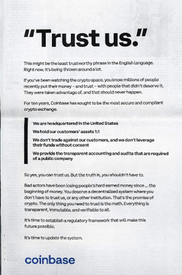
Coinbase’s WSJ Ad, 11/18/2022
30
These predictions were wrong. Yes, shady, and mismanaged companies like FTX have been exposed and dismantled, and critics of blockchain have only been validated by the events. But, if anything, the events in 2022 have proved that blockchain is here to stay. Since the prices of Bitcoin and Ethereum plummeted in the months after the Crypto Bowl, they have since recovered and Bitcoin hit a record high in 2024.[20] Even more importantly, blockchain is finding increasing success beyond just cryptocurrencies, being applied to art through NFTs, real estate through DeFi, and organisations through DAOs. Unlike the dot-com boom in the early 2000s, blockchain has proven its sustainability, even when the hype is gone, and has only grown in its societal importance and applications.
This isn’t necessarily to say that the crypto industry is better off because of the events in 2022. While prices have recovered, the blemish on the industry's record in the public eye has caused potentially irreconcilable trust issues for some consumers — at least for the near future. Rather, the crypto winter served as a wake-up call. On the other side of the embarrassment and economic losses, the industry has been given the opportunity to learn from its mistakes and learn the value of honest, sustainable, and gradual growth. Rather than marketing on FOMO and get-rich-quick ideologies, exchanges must present themselves as the practical and logical solutions to the shortcomings of traditional finance that they really are. More generally, the industry must highlight blockchain’s practical applications in the here and now. This means getting rid of all the filler — the celebrities and provocative slogans seeking to entertain rather than educate. As advertising CEO Mo Faid puts it, “crypto companies have to stop talking about themselves and start talking about how cryptocurrency or blockchain fits into normal people’s lives.”[21]
To their credit, they have begun to do so. Shrinking marketing expenditures indicate that crypto marketers are becoming more judicious and about when, where, and how they promote themselves. This increasing responsibility is a positive sign, as it is well documented that during prosperous periods in the past crypto companies would overspend on campaigns without batting an eye. Reducing the fixation on elaborate marketing has also allowed companies to focus on two important but neglected aspects of their operations — litigation and regulation. Major players in the industry have won some significant ground in courts and amongst regulatory agencies such as BlackRock’s Bitcoin spot ETF and have had an increased capacity to defend themselves in court where need be (for more on law, see Piper Madden’s article on pg. 19).
Final Thoughts
The shift in recent years has not been about surviving in the wake of past failures, but rather about evolving into a more mature and sustainable industry. Companies have begun to focus less on style and more on substance, highlighting the real-world applications of blockchain technology and its potential to reshape finance, art, real estate, and beyond.
While the road ahead is still full of challenges, there is plenty of reason for optimism. The Crypto Winter has given blockchain the chance to prove its resilience and adaptability and has allowed the industry at large to rebrand itself as a practical and responsible young industry. Companies have learned to embrace a more thoughtful approach to marketing and operation, shifting the narrative to ensure that blockchain is not just a buzzword.
Therefore, while the 'Crypto Bowl' was certainly a stumble, it has, in part, created a stronger, more sustainable crypto industry — one that is built not on hype, but on trust, integrity, and genuine value creation. As we look ahead, it's clear that the best is yet to come for blockchain and cryptocurrencies.
31

Algortihmic Securitisation
BY Finn Anderson
32
Throughout history, the practice of encoding and decoding messages in secrecy has been everywhere.
Evidence of encryption dates back to around 1900 BC in ancient Egypt, where hieroglyphic symbols were used to distort messages within the tomb of Khnumhotep II. The inclination to privatise and conceal information has persisted across cultures and time. In the contemporary world, this perennial desire has found renewed significance in the realm of cryptocurrencies. It can be difficult to trust a fully decentralised network that is not governed by a coterie of elected officials without a true grasp of the math behind the system.
It is fundamentally important to understand the technology behind these security systems, especially for those resistant to the validity of cryptocurrencies. Fortunately, there exists a long history behind the construction of the systems currently used. One major staple in cryptography occurred in 1977, wherein the RSA and Diffie-Hellman algorithms were introduced.
These new algorithms were revolutionary; they caused cryptographic schemes to be based on the security of numbers as opposed to a
shared secret between two parties. Essentially, cryptography evolved from the secure transportation of secret codes between parties to having a mathematically secure communication system.
This transformation is founded on the idea that the key used to encrypt data can be made publicly available, while the key used to decrypt the same data can be kept private. Consequently, these are known as public key cryptography systems. These systems need to be easy to encode in one direction and difficult to decode in the other. Algorithms that have this characteristic are called trapdoor functions. The larger the discrepancy in difficulty between the two directions, the stronger the security of the system. The first of these systems is the RSA, named after the men who described the algorithm: Ron Rivest, Adi Shamir, and Leonard Adleman.
Encryption works by taking a random number and applying a mathematical operation to it to obtain another random number. Decryption takes this
number, applies another operation, and arrives back at the initial number. Let's take an example. Firstly, to ensure the numbers we are dealing with aren’t too large, we will pick a maximum value. Any number over this value wraps around, like a clock, back to the first number, keeping it within our range. For an RSA key-pair, pick two prime numbers, say 5 and 11. To obtain our maximum value we simply multiply the two, obtaining 55. Then we pick our public key encryption, say 7. Using the fact that our factors of 55 are 5 and 11 we can apply the Extended Euclidean Algorithm to get our private key.
The Extended Euclidean Algorithm determines the greatest common divisor (gcd) of two values by taking a linear combination of the two of this form:
ax + by = gcd(a,b)
The Extended Euclidean Algorithm is a method for finding the multiplicative inverse of two numbers (in this case, 7 and 77) modulo their product. Modulo simply returns the remainder after dividing two numbers. The goal is to find a number 'd' such that:
(e * d) mod φ(n) = 1
In this case, e = 7 and 55 are known. We need to find 'd', our private key.
- We know our modulus: n = 5 * 11 = 55
- Calculate Euler's totient function: φ(n) = (5-1)(11-1) = 40
- Choose a public key: Let's set e = 7
- Use the Extended Euclidean Algorithm to find the private key ‘d’ such that (e * d) mod φ(n) = 1
Extended Euclidean Algorithm:
a = φ(n) = 40
b = e = 7
Start by expressing a as a multiple of b plus a remainder:
40 = 7 * 5 + 5
7 = 5 * 1 + 2
5 = 2 * 2 + 1
Rewrite the equations backwards to express '1' as a linear combination of φ(n) and e:
1 = 5 - 2 (Substitute 5 = 7 - 5 * 1) * 2
1 = 5 - (7 - 5) * 2 (Expand)
1 = 5 * 3 - 7 * 2
Simplify the equation: (Replace 5 = 40 - 7 * 5)
1 = (40 - 7 * 5) * 3 - 7 * 2
1 = 5 * 3 - 7 * 2 φ(n)
Thus, 'd' will be equal to the coefficient of e (7) in the equation. Therefore, in this case, the private key 'd' is 2.
33
Under the parameters that 77 is the max, 7 is the public key, and 2 is the private key, we can encrypt any number by multiplying it by itself 7 times and then multiplying it by itself 2 times to decrypt it.
For example, if we want to encrypt the number 43:
43 x 43 = 1849, which is over our max of 55, leaving a remainder, or mod, of 34
34 x 43 mod 55 = 64
32 x 43 mod 55 = 1
1 x 43 mod 55 = 43
43 x 43 mod 55 = 34
34 x 43 mod 55 = 32
Therefore, the encrypted version of 43 is 32. To decrypt this message, we multiply 32 by itself 2 times:
32 x 32 mod 55 = 34
34 x 32 mod 55 = 43
If we assign a system of numbers to letters, like UTF-8, we can start to encode messages this way!
Despite the success of this trapdoor function, there are many reasons as to why it is not used in cryptography. The increasing efficiency of factoring algorithms and key growth limitations offer two reasons. The former suggests the gap between factoring large numbers and multiplying large numbers is shrinking, making the RSA less secure. As computational resources increase, the size of keys required for the RSA to maintain security must grow faster. This leads to challenges for low-powered devices with limited computational capabilities, leading to the latter limitation.
Subsequently, in 1985 Neal Koblitz and Victor Miller introduced elliptic curves to the subject of cryptography. This is another trapdoor function that many may be unfamiliar with. An elliptic curve is a set of points that satisfy the following equation:
y^2 = x^3 + ax + b
Bitcoin and Ethereum use Elliptic Curve Cryptography (ECC) to generate a pair of keys. The public key is derived through elliptic curve multiplication, starting from the private key which is a random number. Given the intricacies of trapdoor functions, similar to the RSA, they allow for your public key to be shareable and “public”, without compromising your security. This is called Elliptic Curve Digital Signature Algorithms (ECDSA).
In this system, private keys remain hidden while transactions are made public through mathematical signatures. The ECDSA breakthrough, as recognised by Bitcoin’s creator Satoshi Nakamoto, has allowed for these decentralised global payment systems to flourish.
Let's see how this works. Cryptocurrencies use ECC because a 3071-bit RSA private key is as secure as a 256-bit elliptic curve private key, due to the reasons previously discussed. Bitcoin and Ethereum use the elliptic curve title secp256k1, which simply refers to the following formula and graph:
y^2 = x^3 + 7

The process of using the elliptic curve to generate a public key from a private key is actually quite simple diagrammatically. Similarly to adding two numbers together to get a third, you can add two points on an elliptic curve to get a third point. To add two points, you must find a line that extends from one point, say A, to the other, B, determine where that line intersects a third point, C, and reflect that third point across the x-axis, D. The reflected point ‘D’ is the result of adding our two points together.
For ECC, as opposed to arbitrarily adding two random numbers together, we specify a base point on the curve and add it to itself. As shown below, we draw a line that goes through point A, of which there are infinite. Therefore, we simply take the tangent line of A, finding the third point as we did before, as shown below. Then we add A to itself again, or A+A+A, which we can find by adding A and 2•A together.
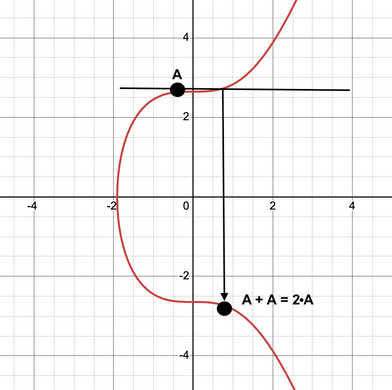
This proves to be tedious, which is the basis of a trapdoor function — easy in one direction and hard in the other, much like the RSA algorithm. The base point for secp256k1 has the following coordinates:
x-coordinate: 55066263022277343669578718895168534326250603453777594175500187360389116729240
y-coordinate:32670510020758816978083085130507043184471273380659243275938904335757337482424
Now, it may remain unclear as to how this system is secure. Let’s clarify. If we compute x•A, where x is a random 256-bit integer, and X is a point on the curve, could you find x? As in, could you determine how many times we added A to itself to get to point X on the curve? Even if you had a super computer, it is infeasible for you to find x. There is no known algorithm for finding x, so your only option is to continuously add A to itself. x will be somewhere between 0 and 2²⁵⁶-1, about 2¹²⁸, taking you, on average, 2¹²⁸ point addition operations to find it.[1] If your supercomputer had the ability to do 1 trillion point additions per second, and you had been running your computer since the inception of the universe, you would have done 2⁹⁸ point addition operations by now.
34
5
Financial Reports
5

ResearchCoin: Reinventing Science As we know it
BY Osian Guthrie
36
“What if crypto as a technology could enable serious societal change?”
When people hear the word ‘crypto’, they picture elaborate ponzi schemes, underground dark web money laundering and obscure dog coins momentarily becoming the new medium of financial exchange. But what if crypto as a technology could enable serious societal change? As the industry continues to push innovation forward, many applications for blockchain and cryptographic technology have been unveiled, in sectors such as AI, real world assets, and science. Yes, blockchain is now disrupting science. First of all, let’s dive into the issues facing science in the 21st Century.
The Problem
For many years, science was a meritocratic realm of academia. Whether it was Newton observing apples falling off a tree and discovering gravity or Aristarchus in 300 B.C estimating the distance between the earth and the moon almost perfectly, science has always rewarded those who have dared to think. However, the modern scientific model has strayed far from its roots. Riddled with corruption, oligopolies,
and gatekeeping, one’s success as a scientist now relies not on the quality of research but rather on popularity and reputation.
The problems with modern science are plentiful. Perhaps the most pressing issue at the heart of the problem is funding. Simply put, for scientists to produce research, they need money – and usually quite a lot of it. Average grant sizes from the National Institute of Health (NIH) have been rising steadily over the last decade, and current average grant sizes sit at over $600,000 per proposal.[1] It can often take a researcher 3 to 5 years to go through the process of applying for funding, completing the research, submitting a paper to journals, having it reviewed and finally getting published. According to Rouse (2016), U.S university faculty members spend “40% of their research time navigating the bureaucratic labyrinth, and the situation is no better in Europe”. To make matters worse, many experts believe that securing research funding is an often biased and inefficient process within the existing system.[2] It was found that, especially when funded by for-profit organizations, scientists tended to skew their results
to support the interests of their funding source.[3]
Moreover, the likelihood of receiving funding is closely tied to a reputation system called the ‘h-index’, which is depended on by all scientific institutions to gauge ‘impact’. This sadly incentivises researchers to publish a high volume of papers – a ‘publish or perish’ mentality, if you will – rather than focusing on the quality of their work, further distracting scientists from realising potentially ground-breaking discoveries.
Many of the world’s successful scientific papers flow through one of the big three scientific journals: Science Magazine, Nature or Proceedings of the National Academy of Sciences (PNAS). While on the surface they appear to celebrate new and world-changing discoveries, the monopoly they have on the publishing game tells another story. Indeed, according to a study by WIPO, 53.6% of articles flowed through the top five publishers in 2020.[4] This centralisation essentially puts the decision of what to publish in the hands of the profit-driven CEOs of these journals, who make money from showcasing these novel breakthroughs
and garnering more subscriptions as opposed to potentially more important but less flashy research.
In fact, Nature also charges the scientists themselves, reportedly over $11,000 per paper in some cases. As a result, scientific data is gate-kept under paywall and stored in disjointed databases across multiple journals, keeping scientists with fewer resources away from important information needed to run other studies.[5]
So how do we solve this? Efforts have been made by initiatives such as Open Science, but to minimal effect.[6] Yet it is clear to see that science’s existing model relies upon centralisation. This is where Decentralised Science (DeSci) comes in.

37

Source: www.researchhub.com
Decentralised Science
What actually is ResearchHub?
Decentralised Science, empowered by the permissionless nature of blockchain technology, is a movement designed to increase scientific funding, eliminate reliance on profit-hungry intermediaries, and increase collaboration across the field. At the core of DeSci are DAOs (Decentralised Autonomous Organisations), which essentially act as independent communities, often with quite sizeable treasuries, that work towards fulfilling their communal goal. They often target specific aspects of scientific research, such as funding, peer review, incentives and access. For example, VitaDAO is dedicated to funding and advancing early stage longevity research, while PsyDAO channels funds into unlocking the power of psychedelics as a viable remedy for mental health issues.
Because blockchain technology allows for permissionless ownership (at its core, it is a string of transactions that are verified, through the use of an extremely sophisticated cryptographic algorithm, by many different participants across the globe), it has the potential to revolutionise science in many ways. Scientists will have rightful ownership of their own intellectual property, as opposed to universities that take the claim for research in return for funding, salary and recognition. Data will be published to the decentralised ledger and will therefore be open for everyone to access, incentivising good and honest practices away from the skewed motives brought about by private funding.
In fact, blockchain also creates the possibility of alternative, more fair funding models such as quadratic funding, deemed by Gitcoin as the “mathematically optimal way to fund an ecosystem democratically.”[7] Quadratic funding is essentially a crowd-funding mechanism that amplifies available resources by inviting community members to make donations that act as votes on where to allocate funds.[8]
DeSci is still very much in its infancy and it is certain that many of its main applications have not yet been built, but what is currently available on the market is extremely promising. Another application of blockchain is tokenisation and its financial incentives, which leads me on to the topic of this thesis: ResearchCoin.
Let me present to you ResearchCoin… or ResearchHub, as the product is called. Founded by Brian Armstrong, the CEO and founder of Coinbase, its mission is to accelerate the academic community by creating a platform upon which scientists can collaborate on research in a much more efficient way, similar to what GitHub has done for software engineering.[9]
Researchers can upload articles in PDF form, summarise the findings of the work in an attached wiki, and discuss the findings in a completely open and accessible forum dedicated solely to the relevant article.[10]
The idea was sparked by a blogpost created by Armstrong in 2019, in which he laid out in detail the problem with current science as well as his proposed solutions.[11] Among his numerous suggestions was the proposal to break away from scientific papers as an ‘end result’, and instead have collaboration throughout the process.[12]
Where does ResearchCoin come in?
Integral to what ResearchHub has built is ResearchCoin (RSC), the token native to the platform. Users can earn RSC by sharing, curating and discussing topics within the platform, and even set bounties for questions they want answering or papers they want peer-reviewed. For example, a user created a bounty of 350 RSC or $140 at current prices for someone to recommend them an AI tool to help analyse biological samples for their PhD. In a similar way to Reddit Karma, you can tip people with RSC if they have made a particularly impressive contribution.
This kind of incentive-based tokenization system is not particularly new within crypto (native tokens are used as incentives on exchanges such as Binance, for example, where users can hold BNB in their wallet and receive reduced fees on selected markets), but is certainly a use-case that can be leveraged more cleverly to make existing systems more efficient.
38
Tokenomics
To really get an understanding of the value of RSC, we need to look at how the token is distributed. There is a total of 1 billion ResearchCoin in existence, with following allocations:
- 60% allocated to the community and users of ResearchHub
- 20% retained by ResearchHub Technologies, Inc.
- 10% for ResearchHub’s founders
- 10% reserved for paying future ResearchHub employees with equity.
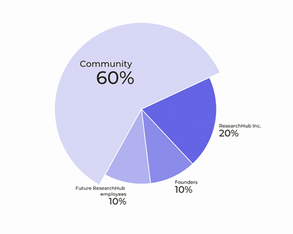
As token distributions in crypto go, a 60% allocation for the community is pretty generous. If we take Wormhole ($W), the most recent airdrop as of the time of writing, the community allocation lies at a measly 17%, while Jupiter, lauded by many as having excellent tokenomics, has handed over 50% to the community.[13]
Like many token offerings, RSC is subject to a vesting and emission schedule. The team opted to emit tokens over a 12 year time horizon, incentivising the nurturing of a healthy community of contributors. Tokens are released on a per annum basis that is subject to change depending on how the community decides to vote (The current emission rate for the community is 5% per year).
Hubs
In order to create a decentralised version of Github for science, it is essential to address the problem of large, centralised publishers which have a chokehold on the scientific world. In lieu of this problem, ResearchHub has created ‘Hubs’, which are individual forums addressing a specific area of science. For example, there are hubs for chemistry, physics, computer science, machine learning, psychology and so on. This allows for streamlined and open publishing of scientific or academic content directly into these hubs, which removes the gatekeeping process of traditional publishing and allows information dissemination to be accelerated and then peer reviewed post-publication.[14]

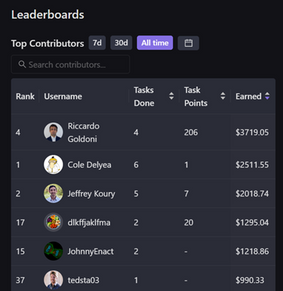
Sources from left to right (clockwise):
https://docs.researchhub.com/researchcoin/rsc—tokenomics;
http://www.researchub.com;
https://www.researchhub.com/leaderboard/users
39
Team
Other than Brian Armstrong, then, who is running the ship day to day? Patrick Joyce, ResearchHub’s Chief Operating Officer, is a recent Medical graduate from Georgetown School of Medicine. He has 4 years of experience as founder of his own company during his degree and founded ResearchHub alongside Armstrong straight out of graduation. According to his ResearchHub profile, he is ‘interested in neuroscience and its clinical applications’. Kobe Attias, the CTO, has over 20 years of experience as a software engineer, including a 6 year stint at Sotheby’s as Director of Engineering. He joined ResearchHub in 2021 as Founding Engineer.
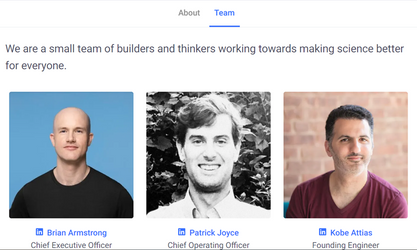
Source: Brian Armstrong Medium - Update on ResearchHub and ResearchCoin
Investment Thesis
To preface this, I want to highlight a particular heuristic echoed by many of the world’s leading investors.
“The consensus is often wrong, so I have to be an independent thinker. To make any money you have to be right when they're wrong.” – Ray Dalio [15]
You make the most money when you are early to a brilliant idea before everyone else thinks it’s brilliant. Investing early on into Facebook comes to mind — imagine realising the potential of connecting many people over the internet into one place. Another one is Uber, and another one is Bitcoin. And I believe there is strong evidence to believe that we have a brilliant idea on our hands here.
The investment thesis for RSC can be expressed very simply as the following: coin created by the most successful founder in crypto with multiple bullish catalysts coming up as well as a functional product with a large amount of already acquired users sitting at a criminally low market cap in a sector yet to be properly discovered by the rest of the market. Now, if that didn’t make much sense, let’s break it down in more detail.
First of all, from a top-down perspective, let’s evaluate the extent to which the DeSci sector is an attractive investment. According to CoinMarketCap at the time of writing, the market cap of the entire sector lies at a mere $800m. To put this in perspective, $WIF, the meme coin of the moment, has a market cap of over $2bn and the AI sector currently sits at almost $20bn. But, in the attention economy and with AI all the rage, why would anyone really be looking at DeSci?
Well, humans are predicted to make significant advances in the realms of biotechnology in the 21st Century.[16] Indeed, if, as Yuval Noah Harari suggests in his book Homo Sapiens, humans are able to solve ‘old age and death as technical problems’ and achieve longevity, then there is much opportunity investing in such a potentially life-changing (and indeed life-lengthening) technology.[17] Achieving longevity isn’t some sort of pipe-dream — people are working on this problem right now. Bill Gates, Peter Thiel, and Brian Armstrong, who, alongside ResearchHub and Coinbase, has started his own longevity business called NewLimit, are all deeply involved.[18][19][20]
The fact that Armstrong first founded ResearchHub and then NewLimit highlights the opportunity here. In order to reach longevity, or indeed any other homo-sapien altering breakthrough such as ASI (Artificial Super Intelligence), more quickly and efficiently, science needs to change. And DeSci is the answer.
This is reason to believe that DeSci as a sector, sitting at a cumulative market cap (~1/20th the size of that of Artificial Intelligence), is ripe for upside.
Within DeSci, then, how does ResearchHub fit in? Current notable projects include molecule [21], which “is a protocol, marketplace and service provider to the DeSci community” [22] and has set up an incubating program for budding DeSci projects/founders seeking funding. It has funded the largest DAOs (Decentralised Autonomous Organisations) in the sector, namely VitaDAO, which focuses specifically on longevity research, PsyDAO, furthering research into psychedelic medicine, and CryoDAO, pushing forward the field of cryopreservation.
The sector is certainly very young, with over 50% of the projects being built in the past year alone.[23] Yet, ResearchHub, with its established user base of over 40,000, extremely active discussion forums, and prestigious team, stands out.
40
Macro Analysis
Numerous recent developments also seem bullish for $RSC. Coinbase is currently in an ongoing legal battle against the SEC, and with rumours about their impending victory ramping up, $RSC, as a proxy coin for Brian Armstrong’s success, is set to benefit.[24] Moreover, $RSC has recently gone live on Base chain, Coinbase’s official native blockchain, whose TVL has very recently hit an all-time high of over $4bn.[25] This move will allow for reduced fees (base fees are currently 100x cheaper than those of Ethereum) as well as increased accessibility (Base chain will integrate directly into the coinbase product suites and therefore have instant access to over 56 million users).[26]

The entire crypto market, aside from a few rare price dislocations (e.g see $RLB’s monster bear market rally from July to November 2023), moves in tandem with Bitcoin. When Bitcoin does well, the whole crypto market does too, and the rotation game within the ecosystem will commence wherein the hot ball of liquidity flows from narrative to narrative, generating obscene amounts of wealth for the well positioned, until Bitcoin tops. When Bitcoin does badly, the entire market nukes and remains muted until Bitcoin goes up again.
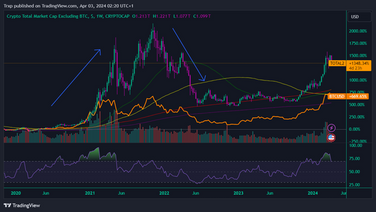
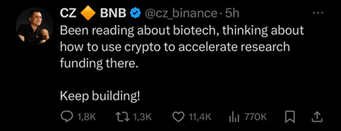
Source: www.twitter.com/brian_armstrong; www.twitter.com/cz_binance; two of the biggest players in the entire space are interested in DeSci
It also must be noted that, with Brian Armstrong as founder, it is only a matter of time until $RSC is listed on Coinbase’s exchange, which brings further attention and a whole host of new potential buyers.
Ultimately, $RSC presents itself as an asymmetric trade with many, many bullish overheads. A quick Twitter search of “$RSC” shows that very few people are aware of its presence, while its market cap continues to march up. Once the wider market begins to latch on, which only becomes more likely as the price rises, $RSC has potential to reach much higher valuations.
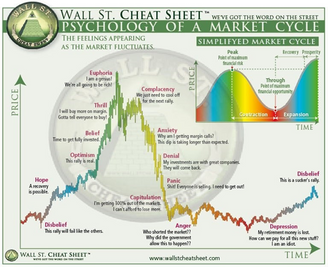
Crypto Total Market Cap Excluding BTC, vs BTCUSD in orange; The upwards arrow denotes how when BTC rises, so too does the entire crypto market. When BTC tops, the market continues upwards as participants continue piling money into the system thinking that ‘this time is different’. When BTC inevitably crashes, as shown by the downwards arrow, it pulls down the entire market with it. After this point, a bear market begins and BTC and the rest of the market moves in tandem.
So, what do the conditions look like for Bitcoin to succeed in the future? Looking at the long term first, the thesis for Bitcoin is simple. World government debt has never been higher (figure below). Governments can print money and issue debt at their will. Populations, in countries such as South Korea and Japan, are facing grave depopulation issues.[27] Global instability, with major wars in Ukraine and Russia and Israel and Palestine, is on the rise.
41
The world is becoming increasingly digital and Bitcoin, with a hard supply cap of 21 million bitcoins and fully decentralised, is hard digital money. The thesis for Bitcoin is the same as the thesis for gold.
Hard assets are and always will be hedges against fiat currency by nature of their inherent value. De-dollarisation is nothing new, and the short USD long BTC thesis has been speculated upon by names such as Ray Dalio in his book The New World Order, as well as more recently BlackRock CEO Larry Fink.[28] Bitcoin at the same market cap as gold puts the price at $600,000 per Bitcoin, a 9.2x away at current prices, and therein lies the opportunity.
Within crypto then, what do the catalysts look like? The Bitcoin halving happens on 15th April, in which the block reward handed out for successfully mining a block halves (as an inherent hedge against inflation), which has historically preceded appreciation in price (see chart below).
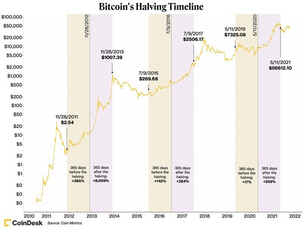
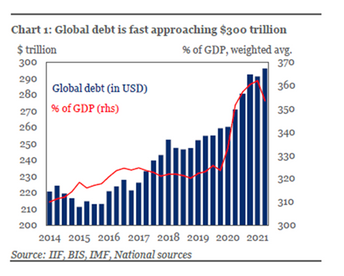
Additionally, the Bitcoin MVRV chart, which compares the current market value (MV) of bitcoin (price*total supply = MV) to the realized market value (RV) (the sumproduct of price* unit supply at the time each unit last moved onchain = RV). It essentially estimates how much profit people are in and therefore how likely they are to sell. A ratio under 1 is golden. A ratio over 3 has always marked a cycle top.[30] Sitting at a current MVRV score of 1.7, the current bull cycle is well under way, but has yet to reach its ignition stage. To compare with last cycle, Bitcoin sat at a price of $16k when the MVRV score was at 1.7, and went on to 4.3x from there before reaching a MVRV score of 3+, while the entire crypto market added $2tn+ worth of value.
In the short term, say 1-3 years, the macro headwinds are strong. The launch of the recent BTC ETF by names such as Blackrock, Fidelity and VanEck indicate the level of institutional interest in digital assets. Crypto is slowly becoming more accepted by more serious players, and with ETH ETFs already on the horizon, this progress shows no sign of stopping.[29] 2024 is also election year and historically elections are positive for markets, as the current president lowers interest rates in order to stimulate economic growth in an attempt to brag about the success of their term and achieve re-election (see Figure below).
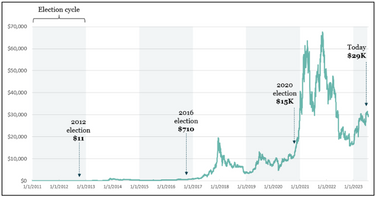
Source: coinmetrics.io
It is clear then that Bitcoin, and by extension the wider crypto market, is experiencing prime conditions for growth. However, it must also be noted that Bitcoin has increased almost 300% in the last year and therefore caution must be taken, especially given that the price is currently hovering around all-time-highs. A clean break above said highs, followed by follow through with momentum, would indicate full risk-on.
42
Source: https://cryptopotato.com/grayscales—curious—graph—of—us—presidential—elections—and—bitcoins—price/
Conclusion
As discussed, with conditions primed for Bitcoin, the rest of the crypto market is primed to rapidly reprice. And with the DeSci sector sitting at a fraction of the current market cap of a meme coin of a dog wif a hat, I believe there is serious room for growth here, with RSC, with its independent headwinds, set to benefit hugely.
Technical Analysis
Bitcoin is currently consolidating above its previous all-time highs. And while this level is held, crypto is ripe for serious upside. With that being said, a break below into the previous range is obviously bearish and will indicate lower prices.
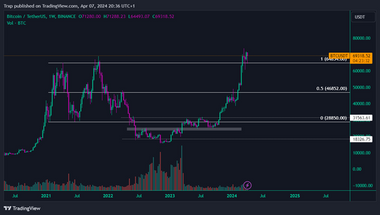
Source: tradingview.com
Ultimately, $RSC is an excellent investment in the near term as a result of its macro and micro bullish headwinds. With the narrative of DeSci yet to enter the wider markets’ general consciousness, and with $RSC positioned as essentially the flagship of this sector, as well as having its own individual assets such as its founder Brian Armstrong and the recent launch on Base, it can be seen as a trade with a pretty good risk:reward ratio. In the words of great hedge fund manager Peter Lynch, “know what you own and why you own it”. I hope this report has provided some insight into the strengths (and, if you can find them, weaknesses) of $RSC as a potential investment.
The Bitcoin chart is important, as it tells us the general health of the wider crypto market.
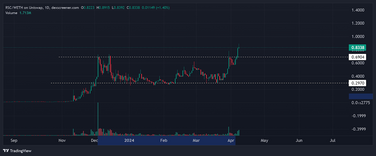
Source: tradingview.com
$RSC, then, has just broken upwards out of its 5 month long range, an event that usually causes an explosive increase in price.
43

XRP
BY LAUREN RAE
44
REPORT ON XRP
History
In 2004, Ryan Fugger developed the initial foundation of Ripplepay, a technology company which we now know today as Ripple. Fugger was a Canadian web developer headquartered in Vancouver who sought to produce a new innovative way of secure payment and lending transactions without intermediary involvement. This system was quickly launched and adopted worldwide in 2005 with the aim being to introduce a virtual currency that was easy for individuals and communities to use as a medium of exchange. However, in 2011 Ripplepay was sold to Jed McCaleb, Arthur Britto and David Schwartz.[1]
Despite having similar ideas to Fugger, the trio rebranded the company to Opencoin intending to use it to cater to international money transfers. Shortly after, they relaunched as Ripple in December of 2012, XRP. In 2013 the company was swiftly rebranded to Ripple Labs due to customers referring to the coin, Ripple, as XRP and this decision has set the company and its assets more aligned.[2]
Founding Team
Jeb MacCaleb is an American programmer who is renowned within the crypto and technological field. The self-made entrepreneur began his career in the early 2000s when creating eDonkey2000 which became one of the largest file sharing platforms. He progressed onto developing video games before eventually landing his first role in the cryptocurrency sphere in 2010 when he created the first major Bitcoin exchange, Mt. Gox.[3] This cryptocurrency exchange conducted 70% of Bitcoin’s transactions during its most successful period but it was declared bankrupt soon after which led MacCaleb to become a co-founder of Ripple.[4] Shortly after the XRP launch, he left the company due to a series of disagreements that were based on investors and fellow co-founders rejecting his ‘bad’ ideas such as dumping XRP.
Out of spite, MacCaleb made it his mission to create a direct competitor of XRP with a new coin called XLM. This coin did not succeed as McCaleb implemented his ideas which were rejected by XRP co-founders and ended up damaging the coin. One of the first things McCaleb did with XLM that he wished to do with XRP was a Facebook giveaway of the coin. This eventually proved his original idea would have been unsuccessful. Furthermore, as some of XLM is pre-mined there is an uneven supply balance of the coin and the Facebook giveaway lead investors to grow suspicious of it’s future strength within the market.[5]

JEB MACCALEB
10
45
The mysterious Arthur Britto has remained faceless and private throughout his whole career.[6] It is assumed that he is an American programmer with some Ripple fans linking him to the development of video game software, dating back before the turn of the millennium. Some Ripple followers even speculate about the mere existence of the cofounder as so little is disclosed about him.
Unlike his other cofounder, David Schwartz, the CTO of Ripple, is persistently in the public eye due to his passion for XRP. Before joining Ripple, Schwartz was always fascinated with security and programming as he was the designer of a cloud-based storage system for WebMaster, which tracked and managed all activity related to various websites.[7]
Since 2011, Schwartz has been devoted to developing Ripple to disrupt the Society for Worldwide Interbank Financial Telecommunications (SWIFT). SWIFT is one of the world’s largest systems where international money is traded and transferred securely and accurately. This is because Schwartz wants to eliminate SWIFT from being an intermediary in transactions. He notes its inefficiency, as it can take up to three days with volatile fees to complete a transaction. XRP, conversely, strives for rapid transactions with low fees.[8]
Utility
The foundation of XRP was mainly inspired by the crypto market’s biggest competitor, Bitcoin. XRP has 100 billion coins pre-mined with Ripple’s team and co-founders receiving 20 billion coins amongst them and 25 billion being held by Ripple. The remaining 55 billion is available for public consumption but they are not all distributed at once as they are released in batches of 1 billion per month, allowing a stable supply of the coin. A stable supply is vital as it reduces price volatility, attracting more risk-averse investors. This creates stability within XRP's network allowing the coin to serve a purpose much like SWIFT’s.[9]
The primary reason for the coin’s creation is to allow for a cost-effective and swift way of trading and exchanging fiat currencies and cryptocurrencies on an international level. This ambition stemmed from the desire for competition within the crypto space. Additionally, XRP aspired to be both more sustainable and efficient than Bitcoin, which will be expounded upon later.[10]

Authur Britto David Schwartz
(De)centralized
Schwartz’s desire to disrupt SWIFT created controversy for XRP. Ripple Labs partnered with banks and financial institutions, such as the Bank of America, to smooth cross-border payments.[11] This connection to financial systems worried crypto investors who prioritized decentralized payment.[12] This could lead to the coin appearing less desirable as it loses out on more efficient transaction features if connected to any centralized financial institutions. Further, any failure incurred by the banks will have a knock on effect to XRP. These commercial banks condone XRP as they can create Real-Time Gross Settlements (RTGS) for international trade, allowing settlement risks to be avoided as transactions will be indefinitely and successfully completed.[13]
Bitcoin vs XRP
Both Bitcoin and XRP are decentralized coins, however they are distributed in different ways. Bitcoin is powered by blockchain technology, which records and verifies transactions on a public ledger. The security of the transactions are monitored by a consensus mechanism called Proof of Work where miners solve intricate calculations using powerful computers.[14] These computers generate copious amounts of energy which has a negative environmental impact and lengthy calculation times. Comparatively, XRP is stored and created on its own blockchain technology, the XRP ledger.[15]
Unlike Bitcoin, XRP’s supply was all pre-mined before it was launched, causing the coin to avoid lengthy calculations for consumption. This makes it more energy efficient and sustainable as less power is exerted when the coin is being bought and sold. Furthermore, the gas fees (a premium added to the original price of the coin) charged when purchasing the coin is significantly less than its competitors, as the coin already exists so less verification is required. Moreover, XRP does not use Proof of Work but rather a consensus protocol where validators (designed servers) approve the transfers of XRP every few seconds (roughly every 3-5 seconds).[16]
XRP’s Appeal
XRP is a very easy coin to buy as you can buy the coin on crypto exchanges such as Coinbase, Bitstamp and Kraken using fiat currencies or other cryptocurrencies. The coin is supply restricted so therefore only a certain amount can be consumed as eventually there will be no new XRP coins in circulation. However, this does not restrict investors from buying copious amounts of the coin (assuming they do not buy all of the coins in circulation). As stated earlier once all coins that are mined are bought there is no more supply of XRP. Therefore, the only limits are the supply, which is said to take years to diminish, and how much investors are willing to invest.[17]
46
Investors may be hesitant to hold the coin due to such volatile prices. All cryptocurrencies face these price fluctuations which can lead to sudden and drastic price hikes or dips. The coin saw very little movement in its first few years until it soared at the beginning of the bull market in 2017.[18] By 2018, the coin’s price had significantly increased by 1820% ($0.2 to $3.84), but this was short-lived as the currency plummeted 93% soon after.[19] The fluctuations faced by the coin seem to be a pattern, throughout a bull market the price spikes then steadily drops over later months.
Future expectations of cryptocurrencies are unreliable as professional investor Thomas Kralow demonstrated this as he predicted XRP to be $30 per coin in 2023.[20] This indicates that despite being knowledgeable in the realms of investing, cryptocurrencies are extremely unpredictable and volatile. Within the crypto space, this should be no shock as the majority of investors are aware of the volatility and risk so these price fluctuations may not play a detrimental role in their investment decisions. Uncertainty is prominent in XRP’s market, as we are yet to see a persistent price rise followed by a constant and stable price consolidation. This may be off-putting for some investors due to the lack of stability of the coin.
Weaknesses
Centralisation has caused XRP to suffer. Due to the coin being pre-mined and verified by validators, fewer security checks may be conducted on the blockchain. This means that security may be redundant in this case due to less frequent checks. Ripple uses a consensus algorithm called the Ripple Protocol Consensus Algorithm (RPCA) to increase the security of the network. This consensus should protect the software from potential hackers. Nevertheless, this is not always the case, as at the end of January 2024 XRP was hacked. A Ripple co-founder, Chris Larsden, faced a substantial personal loss of $113 million as a result of the breach, which would have been amplified had Ripple not reacted so swiftly and froze the assets that were affected.[21] This reminds the community that hacking and fraudulent activities are still possible despite the complexities and intricacies of the blockchain.
SEC vs Ripple
In January 2024, the U.S Securities and Exchange Commission; (SEC) requested for XRP to provide financial statements. This links back to the lawsuit filed against XRP and SEC in 2020. The SEC believed that Ripple was selling XRP on secondary platforms whilst disobeying constituent security transactions. However, when XRP is sold to financial institutions it does comply with constituent security transactions. Due to this accusation, XRP had to undergo the Howdy Test which is a legal test establishing whether a transaction is deemed as a security under the law.[22] Surprisingly, Ripple did not confirm or pay fines but rather explained that they were never notified of XRP being recognised as a security.[23]
Furthermore, it was suggested that the SEC was biased in their approach as Ethereum never experienced any legal difficulty. The SEC justified their protection of Ethereum as ICO investors never experienced any financial loss from their initial investments into Ethereum so therefore could not classify ETH as a security.[24] On July 13th 2023, XRP won the case against the SEC but recently Ripple is undergoing investigations due to the SEC requesting an appeal of the case.[25]
However, this on-going lawsuit of 3 years did cause some difficulty for the cryptocurrency. In 2021, the SEC filed the claims about XRP damaging the coin’s reputation just before one of the biggest bull markets in several years. Also, the coin was delisted from Coinbase, a public trading company that allows the exchange of cryptocurrencies. This caused massive price instabilities, as investors raised concern over the projects future. This triggered the price to fall dramatically during the trial from $0.7 to $0.2. After many tribulations, XRP emerged victorious, causing the coin to soar 80% overnight.[26] It is apparent that XRP has not seen a sustained price rise in many years due to the prolonged lawsuit. Therefore, while its reputation was originally damaged, the coin peaked the interest of many investors because of it’s victory in court.[27]
The SEC has appealed the previous case as they believe that XRP should face consequences of not listing the coin as a security in transactions with investors.[28]
There is mass speculation that XRP will win this legal battle again in mid April and “rally to $1”. This is a bold claim but at the beginning of March the coin increased 30%.[29] This could be attributed to the movement of larger coins within the crypto market, as Bitcoin reached an all time high of around $70,000, leading many other projects, including XRP to follow.[30] Moreover, these bullish conditions, and a potential win for XRP, could cause the coin to increase its viability, painting an optimistic future for Ripple.
Dubai’s relationship with XRP
Dubai has endorsed XRP as a form of payment for oil trades, which opens the market for future cryptocurrency transactions for commodities. XRP stands out against other coins as it has quick payment processing and lower fees, making it more attractive to adopt. Even bank transactions can take lengthy periods (one to five working days) [31] to reach suppliers, due to various factors such as time zones, holidays and differing currencies.[32]
Dubai is known to welcome new innovative cryptocurrencies, and have done so previously when accepting Ripple’s regulatory approval to operate within the Dubai International Financial Centre.[33] All of these little progressions sheds hope on the future of XRP, as it suggests it could be used for other industries, like commodity transactions.
47
Investment Thesis
The ultimate question is “Should I buy XRP?” As previously outlined, it appears as an appealing investment proposition because of its multiple functions, use in cross-border payments, and adoption in multiple industries. It is worth noting that XRP’s price is higher than usual, but hasn’t hiked significantly since the bull market in Q4 of 2021[34] or the bull market in 2018, which saw the coin soar to nearly $3.[35] The swift bull market in March of 2024 has calmed, showing a fall in the value of XRP, demonstrating that there are always risks incurred with cryptocurrencies. XRP is no exception.
Additionally, it is speculated that Ripple will win its trial vs the SEC on April 19th, leading to bullish interest. As the coin becomes more widely adopted in everyday transactions and affiliated with financial institutions, I believe learning about the project now would be worthwhile and have greater implications in the long run. I do not see the coin as a worthwhile investment in the short run; However, as time goes on, it may become more integrated as a form of payment and thus more valuable to hold.
Macroeconomic Analysis
Recent rumors are causing speculators to believe that the Biden administration will roll out ‘Operation Chokepoint 2.0’, which will contain a similar idea to ‘Operation Chokepoint’, originally created by the Obama administration. The initiative called ‘Operation Chokepoint’ was created in 2013 to suffocate legal but risky and potentially fraudulent companies from the financial services industry (e.g. payday lenders).[36] In early 2023, The White House released “Roadmap to Mitigate Cryptocurrencies’ Risks,” which was a warning from Biden and his governmental team that cryptocurrency assets should be wary. Furthermore, restrictions became progressively worse as a Digital Asset Mining Energy (DAME) excise tax was implemented to discourage state banks from issuing cryptocurrencies and prevent working on blockchain networks. They stressed that previous safe and sound banking systems should remain. However, these taxes can be justified. They were instituted to compensate for the energy and emissions emitted by the consensus mechanism (mining) process. As discussed above,, issuing cryptocurrencies exerts a lot of energy. It is clear that the Biden administration is against the idea of these decentralized currencies and wishes for the original and centralized management of the financial system to stay as they fear the volatility and lack of control.[37]
Despite such efforts to steer the masses away from cryptocurrencies and the blockchain network, we must look forward to the 2024 US presidential elections. With Biden and Trump being the two main competitors, the outcome will have an immense impact on the crypto community. The Biden administration has demonstrated their scepticism of decentralized networks, as did Trump in 2019:[38]
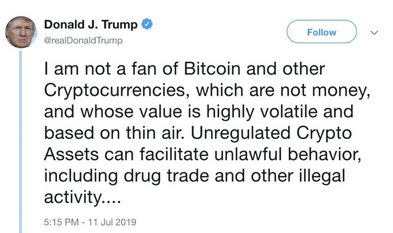
After leaving office, he has suggested that if he returns, he will look upon cryptocurrencies more favourably. According to official reports, Trump owned $2.8 million in various cryptocurrencies in August of 2023, which indicates a change from his previous tweet.[40] In a recent interview, Trump stated that he was surprised that the majority of buyers of his apparel paid through cryptocurrencies,. He also admitted that he “sometimes will let people pay through bitcoin,” further demonstrating his acceptance of cryptocurrencies.[41] Trumps comments have changed his perception amongst crypto audiences, with recent projects showing that 48% of WEb3 investors intend to vote for Trump while 39% aim to vote for Biden.[42] Consequently, this can impact XRP’s market value; if Biden remains in office, it could lead to further declines in prices due to increasing regulation, while Trump’s personal views seem to be promising for the industry.
Cryptocurrencies continue to penetrate a breadth of industries, as evidenced by their inclusion in AI, gaming, and digital art. The gaming industry is becoming larger day by day through new technological advances and opportunities. For example, a new GameFi coin called ScapesMania was launched in February 2024, which has seen massive growth due to speculation over its promising future. The founding team of ScapesMania has received immense praise for the coin, and even received a grant by a predominant player within the blockchain industry. There is concern that this has shifted investor attention from XRP towards ScapesMania, as the new project prioritises its community. This boosting engagement may cause even more investors to move as XRP’s price continues to lack lustre.[43] GameFi tokens are becoming popular as they allow players to buy video games that are powered by the blockchain.[44] XRP enthusiasts can only hope that greater future support of cross border payments will rekindle confidence and optimism in the project within the larger cryptocurrency community.
Another big consumer trend was NFTs (non-fungible tokens), which exploded in 2021 alongside the crypto bull run, but saw a massive decline in 2022. NFTs are unique cryptographic tokens created on the blockchain that possess individual property rights, avoiding the potential replication of an asset. In December of 2023 there was a resurgence of NFTs as they play a driving factor in Web3. Web3 is an umbrella term for all the operations within the crypto sphere, as it represents the decentralized internet and the foundation of secure and efficient transactions.[44] It is assumed the rebound of the NFT market will differ as there will be more affordable assets sold in higher quantities, as opposed to one off art at extortionate prices. This new approach in NFTs will not only affect XRP but all cryptocurrencies.
48
Another influence of macroeconomic trends is traditional financial innovations. Recently, Bitcoin was approved as an ETF (Bitcoin Exchange Traded Funds) which tracks the underlying performance of Bitcoin. Being listed as an ETF allows Bitcoin to now be exposed more easily to retail investors, as they no longer have to set up wallets or learn primitive blockchain concepts.[45] This passing of a Bitcoin EFT shapes a promising future within the community as it may allow cryptocurrencies to be seen in a more positive light. Moreover, there is discussion about the approval of an ETF for Ethereum, which follows Bitcoin as the 2nd biggest leader by market cap in crypto. This creates hope for coins like XRP as the coin is the 6th largest in terms of market cap and therefore has the potential of being considered for an ETF.[46]
With that being said, Bitcoin being an ETF does not ensure or promise that other currencies will be approved as Eric Balchunas, Bloomberg’s senior ETF analyst, claims “there is only a 25% chance that the SEC approves a spot Ethereum ETF.”[47] This indicates that we are a long way away from seeing any further movements with future cryptocurrency ETFs. This could mean XRP, along with many other currencies, will not see the possibility of an ETF. However, XRP’s cross-border payment system may allow for them to be approved for an ETF with more ease, if it is adopted with greater acceptance worldwide.
Technical Analysis
From analyzing the graph of XRP one can notice that the coin embraces its volatility. Seemingly, the coin tends to bounce back and forth over the support region indicating continuous supply and demand imbalances. Throughout the last month, XRP has mainly remained above the support region, as investors have had a greater willingness to purchase the coin. This may be due to the recent bullish conditions within the crypto market.[48] However, the beginning of April has shown a period of resistance, with the price even falling below the support region. This may be subject to the upcoming trial between XRP and the SEC, as investors may be concerned that the outcome will not be in the favor of the coin.[49]
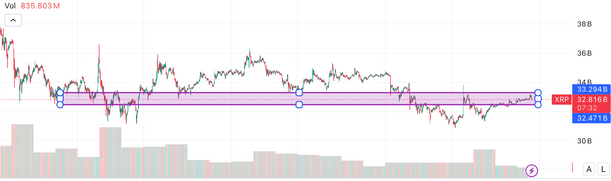

Furthermore, the graph below represents XRP’s market cap and Relative Strength Index (RSI) which displays if a coin is overbought or oversold. In XRP’s case, they normally stay within the middle region so the coin is not drastically oversold or overbought. When the RSI exceeds 70 this shows periods where the coin has been overbought, and when the RSI falls lower than 30 the coin is oversold.[50]
Earlier in March the RSI greatly exceeded 70 when the market cap rocketed to 40 billion (nearly 10 billion greater than days before). This was due to the price rise of Bitcoin, causing all other coins to follow and experience this heightened demand. From this large rise, we can see the RSI falls back within the middle region due to investor corrective action. XRP has an adjusted overbought RSI of 50 but the coin seems to fluctuate drastically. At the beginning of April, the RSI has dropped below 30. This sudden fall below 30 may stem from concerns over the upcoming trail. However, the market cap has begun to gradually climb back to the support level as RSI rises with it.[51]
As discussed, XRP will have an unstable price due to its volatility and from analyzing the graphs above, based on assumption I predict the price and market cap of XRP may fall in future. The reason being is from technical analysis that there are bearish conditions as at the beginning of April the RSI nearly broke the oversold region of 70 and then declined to just below 70 before the RSI fell to a new low. The price can be seen to already mimic this fall as the market cap fell showing investors sold the coin.[52]
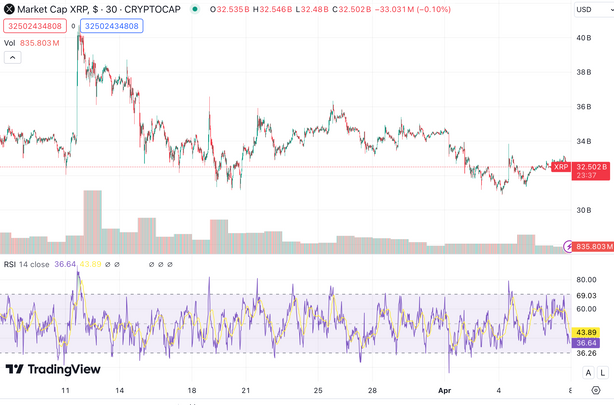
Conclusion
I believe the price of XRP will be highly dependent on the outcome of the trial in the middle of April, which will bring an interesting future for the coin. Moreover, before the trial commences the stability of XRP will be uncertain, but based on research XRP is projected to win the case which, as discussed previously, could launch the coin’s market cap like it did in July of 2023. As the coin becomes more recognised, this will only present more opportunities for those who hold XRP, as cross border payments may become more prevalent with potentially more commodities being purchased with the coin. Therefore, I conclude that, assuming a positive trial outcome, XRP has a prosperous future and could play a massive part in transforming the current crypto market situation and increasing adoption and acceptance of the currency.
49


Bridging Real-World Data and Blockchain: chainlink
by: zara amani ward
50
REPORT ON CHAINLINK
“From its inception in 2017, Chainlink has evolved from a simple oracle for off-chain data to a complex network offering various decentralized services such as price feeds, event data, and computation.”
Utility, History & Founding Team
Chainlink, a decentralized oracle network, was created to bridge the gap between blockchain smart contracts and real-world data. Founded in 2017 by Sergey Nazarov and Steve Ellis, Chainlink addresses a fundamental problem in the blockchain ecosystem: the inability of smart contracts to access external data directly.[1] This limitation restricts the potential use cases of smart contracts to those only relying on on-chain data. By providing reliable, tamper-proof data to smart contracts on any blockchain, Chainlink enhances their utility, making them more applicable to a broad range of industries, including finance, insurance, and supply chains.[2]
Utility and Problem-Solving:
Chainlink was conceived to tackle the "oracle problem" in blockchain technology;
this problem refers to the challenge of securely integrating real-world data into smart contracts without sacrificing the decentralized benefits of blockchain. So, Chainlink’s utility lies in its ability to dynamically feed smart contracts with external, off-chain data in a secure and decentralized manner. This utility therefore broadens the applicability and functionality of blockchain applications across various sectors.[3]
Founding Team and Background:
Sergey Nazarov co-founded Chainlink with a rich background in both entrepreneurship and decentralized technologies. Known for his deep understanding of smart contracts and decentralized consensus, Nazarov was instrumental in the conceptualization and development of Chainlink.
Prior to Chainlink, he was involved in several tech startups, gaining valuable experience in network-based business models and decentralized platforms.
His vision for Chainlink was shaped by his keen insights into how blockchain technology could transform data interaction across different systems. Interestingly, Nazarov is often seen as a thought leader in the blockchain space, known for his articulate perspectives on the future of decentralized finance—making him a notable figure in the cryptocurrency community.[4] Steve Ellis, as the co-founder, brought a technical mastery to Chainlink, particularly with his expertise in secure software development. Before Chainlink, Ellis worked on security-critical projects, which equipped him with a profound knowledge of cryptography and systems security.
This experience was crucial in designing Chainlink’s infrastructure to be secure against manipulation and robust under various operational conditions. Ellis is known for his pragmatic approach to technology, often focusing on solving practical issues that arise in the real-world application of blockchain and smart contracts. His contributions ensure that Chainlink remains at the cutting edge of security technology, setting industry standards in secure oracle networks.[5] Together, Nazarov and Ellis form a dynamic team, combining visionary ideas with technical expertise. Their collaborative efforts have not only advanced Chainlink but also contributed significantly to the broader field of blockchain technology.


10
51
Sustainability and Decentralization
Chainlink's design ensures that its data feeds, also known as ‘oracles’, are resistant to manipulation. By aggregating data from multiple sources, it minimizes the risk of any single point of failure, thereby enhancing the sustainability and reliability of its oracle services.[6]
Chainlink's network is designed to be fully decentralized, distributing data sourcing and computation across numerous nodes.
This structure not only enhances the security and reliability of data feeds but also aligns with the ethos of blockchain technology, preventing any single point of control or failure.[7] The sustainable aspect of Chainlink is addressed through its open-source nature and an active ecosystem that supports continuous development and community-driven enhancements. Its economic model is also built to incentivize participation and ensure long-term viability.
Evolution of Chainlink
Chainlink is a platform that aims to bridge the gap between blockchain technology and the real world. To put it simply, blockchains are like secure online ledgers that record transactions and Chainlink acts as a middleman that allows these ledgers to securely interact with external data, such as stock prices or weather reports.[8]
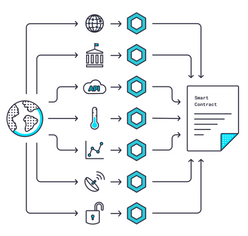
Chainlink nodes validate and relay real-world data to blockchain smart contracts.
The "utility" of Chainlink generally refers to its usefulness or functionality. In the context of Chainlink, its utility is the service it provides to smart contracts. Smart contracts are like automatic agreements that live on the blockchain: they can automatically execute transactions if certain conditions are met, without the need for intermediaries such as banks or lawyers.[9]
However, smart contracts on their own can only manage data that's already on the blockchain. Imagine a farmer who wants to use a smart contract for crop insurance that pays out automatically if there's a drought. The smart contract needs a reliable way to find out if there has been a drought. This is where Chainlink comes in – it securely brings in the needed data from the outside world, like weather information, to the blockchain and the smart contract.
Chainlink was initially established with the primary objective of delivering reliable data to smart contracts. Over time, however, its range of services has broadened significantly. A notable example of this expansion is its role in providing price feeds. Chainlink supplies up-to-date prices of cryptocurrencies, stocks, and commodities to decentralized finance (DeFi) platforms, which operate akin to traditional financial services but function on blockchain technology, thereby bypassing conventional banking institutions. This capability is essential in the financial sector, where accurate and tamper-proof access to current asset prices is crucial for maintaining market stability and ensuring transparent transactions.[10]
Examples:
Aave: A leading DeFi lending platform uses Chainlink's price feeds to get the real-time value of cryptocurrencies used as collateral for loans.
Chainlink has also been used as a tool for Gaming Randomness. In online gaming, fairness is often crucial in elements like loot drop mechanics or critical event occurrences, where the need for unpredictability is key to maintaining game balance and player engagement. Chainlink's VRF provides a source of randomness that is provably fair and cannot be manipulated, ensuring that outcomes, such as the spawning of rare items or the decision of player matchups in competitive games, are just and cannot be predicted or tampered with.[11]
Synthetix: A platform that allows people to trade synthetic assets, which are like copies of real-world assets on the blockchain, relies on Chainlink to determine these assets' prices.
Controversies and Legal Matters
With regards to blockchain projects and cryptocurrencies such as Chainlink, the terms "controversies" and "legal matters" can encompass a range of issues from market manipulation rumors to compliance with evolving regulatory standards.
Market Speculation
Blockchain projects often face speculative trading that can lead to volatile price swings. Speculators may attempt to influence the market, which can lead to allegations of manipulation. Despite the potential for such controversies, Chainlink's decentralized nature and transparency through its open-source code aim to mitigate these risks.[12]
Regulatory Compliance
Cryptocurrencies operate in a dynamic regulatory environment, which can create legal challenges. Compliance with anti-money laundering (AML) laws, securities regulations, and international finance standards is essential. This compliance is crucial because it ensures that cryptocurrencies are not used for illegal activities like money laundering or financing terrorism, and it provides a degree of protection to investors.[13]
52
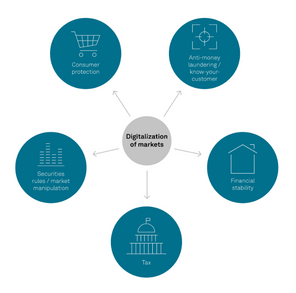
infographic outlining the intersection of cryptocurrency operations with regulatory frameworks and the impact of market digitalization.
Chainlink has not yet been the subject of significant legal actions. However, in the cryptocurrency industry, legal actions can arise, often focusing on allegations of fraud, security vulnerabilities, or breaches of contract. Maintaining transparency and security is crucial for projects to avoid such legal pitfalls. Allegations can arise if there are claims of dishonesty or if someone believes that the project has not followed through on its promises. Chainlink’s commitment to transparency aims to reduce the risk of such allegations and demonstrates the project's integrity to its users and investors.[14]
.
Privacy and Security
The promise of privacy in blockchain is sometimes seen as a double-edged sword. On the one hand, it is a desired feature by users; on the other hand, it can lead to concerns about illicit activities. Chainlink, which provides data feeds to smart contracts, does not inherently anonymize transaction details but focuses on the secure and reliable transmission of data. Still, the platform must continuously adapt to privacy concerns and potential security threats. This balance is crucial because while privacy is valued by users, it should not facilitate illegal actions. Chainlink's focus on secure data transmission is essential in building trust with its users and maintaining the integrity of the smart contracts it supports.[15]
Investment Thesis: Chainlink (LINK)
Buy/Sell Analysis
As for whether to buy Chainlink, the decision should be a cautious 'yes' if one is willing to accept the potential risks for high rewards in a volatile market. This tentative 'buy' is based on Chainlink’s strong market performance and ongoing relevance in the blockchain ecosystem. One should consider selling if adverse market trends emerge
or if Chainlink's technological edge appears to be diminishing. Hold if the current position aligns with your long-term investment strategy and risk profile. It is recommended to frequently reassess as conditions change.[16]
Strength / Weakness
The strength of Chainlink lies in its pioneering role and robust technology, which is generally celebrated by the online community. This positive sentiment is based on its consistent delivery and enabling of advanced functionalities within the blockchain ecosystem. A weakness could be the intensive competition it faces, but Chainlink’s commitment to innovation has so far been a successful countermeasure.[17]
Opportunity / Risk
Chainlink's opportunity lies in its potential to become the standard for data-feed services in smart contracts, which could grow exponentially as the technology matures. The primary risk is market volatility; compared to more established asset classes like stocks or bonds, cryptocurrencies are known for their price swings. In this regard, Chainlink is no exception, though it's noteworthy that its volatility is on par with, or less than, that of similar cryptocurrencies.[18]
Market Conditions and Hypothetical Scenarios
How could market conditions or hypothetical scenarios affect Chainlink? Political shifts, such as regulatory changes, could greatly impact Chainlink's operations. A scenario where governments adopt blockchain technology for data verification could significantly increase the demand for Chainlink’s services, whereas stringent regulations could limit its growth. The adaptability of Chainlink in these scenarios will be critical and is a part of its strategic planning.[19]
Summary Opinion
In conclusion, a 'buy' recommendation for Chainlink is given, considering its solid technological foundation, first-mover advantage, and the growing need for oracle services in blockchain applications. However, this comes with a caveat: investors should be ready for potential short-term fluctuations and should keep an eye on the evolving landscape to ensure Chainlink remains at the cutting edge.[20]
53
Macro Analysis
As a significant entity within the blockchain ecosystem, Chainlink's market performance is closely tied to that of Bitcoin. Typically, when Bitcoin thrives, Chainlink and other cryptocurrencies also tend to see improved performance due to their interconnected nature within the crypto market. This trend reflects the broader investor sentiment and market dynamics that influence the entire cryptocurrency sector.[21]
Crypto Trend Analysis
Long-term Trends (2020 - Early 2023):
Analysis of the total market cap from 2020 to early 2023 reveals a bullish trend peaking around May 2021, followed by a bearish phase indicating a market correction or entry into a bear market. This pattern suggests cyclic fluctuations that are typical in volatile markets like those of cryptocurrencies.[22]
Recent Trends (Late 2023 - 2024):
The latest trends indicate a recovery from the previous downturns, with ascending green candles showing a bullish revival. This upturn, marked by a significant increase in market cap, signals strong buying interest and potentially renewed investor confidence.[23]
- Bullish Phases: Characterized by green candles, these periods denote positive market sentiment and increased investment.
- Bearish Phases: Represented by red candles, these phases reflect negative sentiment and capital withdrawal.
- Momentum Indicators: Tools like the Relative Strength Index (RSI) highlight the speed and changes in price movements. Currently, the RSI suggests a mid-to-upper range activity, pointing towards a potentially overbought market, though specific threshold levels are not detailed.
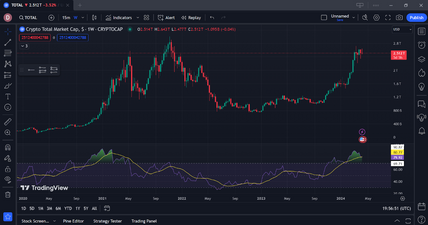
Figure 1 - Macroanalysis of Crypto Total Market Cap
Chainlink Trend Analysis
Chainlink's pricing trends mirror those of the broader market, with significant growth in mid-2021 followed by a decline, hinting at a market correction or bubble burst. Recent patterns show a gradual price recovery, which may indicate a phase of investor accumulation and growing confidence.
- Price Volatility: The peak periods show high volatility, as indicated by long candle wicks. Recent trends show smaller candles, suggesting stabilized volatility.
- Market Sentiment: Shifts between bearish (red candles) and bullish (green candles) sentiments are visible, with a current lean towards bullish sentiment in the latest data.
- Technical Indicators: Chainlink's momentum, tracked by indicators such as the RSI, shows a stable mid-range activity, indicating a balance between buying and selling pressures.
The interconnectivity between Bitcoin and Chainlink showcases how trends in a leading cryptocurrency like Bitcoin can significantly impact other cryptocurrencies. Current analyses indicate a stabilizing crypto market with potential for growth, influenced by global economic conditions and investor sentiment towards digital currencies. This dynamic makes digital currencies more appealing, especially in times of global financial instability, as they provide an alternative investment that diverges from traditional economic influences.
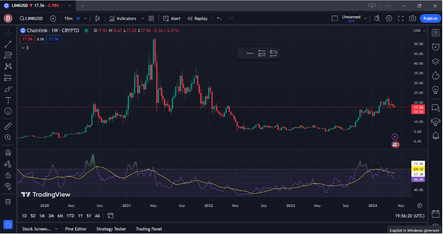
Figure 2 - Chain Link Analysis in the Crypto Market
The Impact of Global Market Instability on Cryptocurrencies
Global Economic Conditions and Cryptocurrency Appeal: The appeal of cryptocurrencies like Bitcoin and Chainlink often intensifies during periods of global instability. As traditional markets experience volatility, cryptocurrencies can seem more attractive due to their decentralized nature, which insulates them from specific geographic economic disruptions.[24]
54
Investor Sentiment and Market Dynamics
The sentiment around cryptocurrencies as a 'safe haven' becomes more pronounced during periods of heightened global economic instability. Investors and governments may look to cryptocurrencies as more stable alternatives to conventional options, which are susceptible to local economic shocks. Figure 3 encapsulates the market's expansion amid the evolving global financial landscape. The analysis of global economic uncertainty and its impact on cryptocurrencies reveals a growing trend in their adoption as protective assets during unstable times.[25]
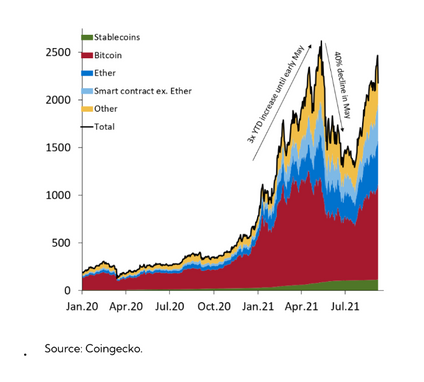
Figure 3: Crypto Asset Market Growth
This stacked area chart shows the market value of different crypto assets from January 2020 to July 2021, highlighting a threefold increase followed by a 40% drop in May, with contributions from assets like Stablecoins, Bitcoin, and Ether.
Conclusion
Cryptocurrencies like Chainlink play an increasingly vital role in the global financial ecosystem, serving both as innovative technological solutions and as a hedge against traditional market instabilities. As the landscape evolves, Chainlink's adaptability and its ability to serve as a reliable data intermediary are likely to dictate its long-term success and influence within the broader crypto market. Continued observation and analysis of its integration into diverse applications will be crucial for understanding its impact on future market trends and investment strategies.[26]
55

Celestia
BY Parker Caleshu
56
REPORT ON CELESTIA
Founder
Mustafa Al-Bassam was born in Baghdad, Iraq in 1995 and migrated to London at the age of 5. He is a computer security researcher, hacker and co—founder of Celestia Labs. Before co—founding Celestia Labs, Al Bassam had quite the tumultuous past, forming the hacker group, LulzSec, in 2011; this group hacked PBS, releasing a fake story that Tupac and Biggie Smalls were alive in New Zealand. They also claimed responsibility for taking the CIA website offline and the Sony hack of 2011 that released personal information, including passwords, addresses and birthdays of millions of PlayStation users. Despite this, Al-Bassam looked to use his skills for better, co-founding Chainspace (a company that was creating a decentralized smart contract system), which ended up being bought by Facebook in 2019. Still interested in securing Blockchain base layers, Al-Bassam created Celestia as part of his PhD in computer science at UCL in 2019, going on to graduate in 2021.
Celestia Labs was founded in 2019 and the company is based in Vaduz, Liechtenstein. The platform released its native cryptocurrency token TIA in October 2023. Since then, the token has become a top-50 crypto coin in terms of price, which has increased by over 500% since its launch.
Celestia’s Goals — Have they Scored?
“The quest for scalability and accessibility in the blockchain world has long been a formidable challenge. Celestia, a pioneering solution that addresses these concerns.”[1]
Celestia was developed with the goal of enhancing blockchain scalability and becoming the world’s first data availability blockchain network. In blockchain terms, a data availability layer provides the ability to access and verify all transaction data in a decentralized network, meaning that any network participant can download transaction data at any time to verify a block.
In Dec 2023, Celestia integrated its data availability solution with Polygon’s chain, bringing the solution to thousands of chains and developers on the MATIC ecosystem. Polygon Labs highlighted the fact that this move drastically reduced the cost of Layer 2 chains that opt to use the Celestia Data Availability solution and estimated that this cost reduction would reduce transaction fees on the chains by 100 times.
Commenting on the planned integration, Polygon Labs Executive Chairman Sandeep Nailwal likened what developers were trying to achieve with the CDK to what fiber optics did for the internet.
“This is the broadband moment for Web3. The ability to launch a high-throughput ZK-powered Ethereum Layer 2 as easily as deploying a smart contract will do for blockchain adoption what high-speed fiber did for Web2 applications,” Nailwal stated. [2]


10
10
57
Utility of Celestia
Celestia allows developers to add their own execution environments on top of the Celestia blockchain. An execution environment is the virtual environment within a blockchain that processes transactions. Developers can do this in the form of a rollup — a Layer 2 blockchain that processes transactions away from the main blockchain to reduce transaction costs and increase throughput on the main chain. Rollups minimize the computational load on the main Layer 1 chain, while also allowing for cheaper and faster transactions. Celestia has the ability to do this as it is a minimal blockchain that only does consensus and data availability, leaving the rest (execution environments) up to the developer. This means that developers have more flexibility in how they make their applications, as they are no longer limited to the smart contract environments on the base layer of the blockchain and can add their own Layer 2s and Rollups instead. This is the new modular blockchain design.
“This modular data availability network not only provides robust security but also seamlessly adapts to the rapidly growing user base, enabling developers to easily launch blockchain projects of their own.”[3]
Modular blockchain is similar to the World Wide Web in that users can have multiple websites running on different servers on the web. Users also have multiple applications running independently on the Celestia blockchain.
With the data availability layer, when a block with new transactions is added to the chain they are verified and released to the public so anyone can see the new block and its trade. This allows Celestia to provide a fully decentralized and safer network for developers and buyers.
Further utility can be found in Celestia’s groundbreaking data throughput ability. Data throughput is, in essence, the amount of data that a blockchain can process at one time. This has a huge influence on the scalability and performance of a blockchain. Celestia has a data throughput of 1 megabit compared to Ethereum which only has a throughput of 10 kilobits, and Bitcoin that has just 1kb/s. So Celestia has 100 times the amount of data throughput as Ethereum, and 1000x the throughput of Bitcoin. As well as having much more throughput than the two biggest cryptocurrencies,
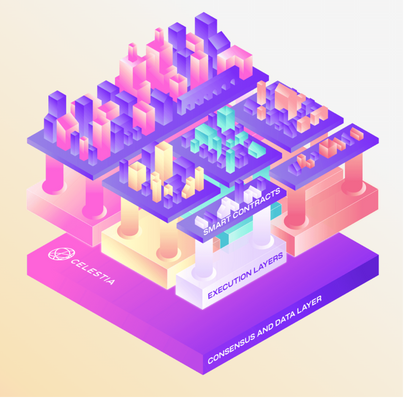
Celestia also offers much cheaper rollups than Ethereum. A combination of cheap rollups, large throughput, and increased scalability allows Celestia to offer much cheaper transaction fees than either Bitcoin or Ethereum.
What is TIA
$TIA is the native coin of the Celestia blockchain.
TIA can be used to partake in Celestia’s consensus mechanism as it operates on a Proof of Stake chain. As TIA is a governance token, those who stake their coins are able to participate in the decentralized governance of Celestia. TIA also performs as a currency for gas prices on the Celestia blockchain. Developers must pay fees in TIA to use Celestia data availability solutions.
Celestia offers more efficient rollups to ethereum
58
Investment Thesis
Opportunities
Nick White (COO at Celestia Labs) and the whole Celestia team see a future where on top of the Celestia blockchain, there are 10,000 rollups. Mustafa Al-Bassam explains that rollups are of extreme importance. He compares their creation to when the cloud was introduced to the web, as it allows developers to have their own fully-customized chain. He goes on to describe how this 10,000 rollup endgame opens up the opportunity to reduce traffic, as each rollup has its own execution resources. So the Layer 1 chain can become incredibly busy and Celestia will still be able to offer space and resources for transactions to take place.
Polygon announced on December 12, 2023, that they are adopting Celestia’s high throughput data availability solution. This will to allow users to build Ethereum Layer 2 chains with much lower fees. With Polygon estimating it will reduce fees by 100 times, it is only a matter of time before other companies opt to use this data availability solution.
There are huge opportunities for gaming and NFT chains on the modular Celestia blockchain because it does not require extreme compatibility. These subsections of chains do not need to be on the same blockchain or execution environment. So, a blockchain like Celestia with many rollups is an ideal platform to facilitate the unique demands of these sectors and position itself as a frontrunner in the growing crypto environment.
Risks
Before looking at the risks of just Celestia, we must first look holistically at the risks all cryptocurrencies have. Crypto is well well known for its volatility, which is a primary concern for prospective investors. The extreme volatility is due to the fact that the crypto markets are wildly influenced by public attention and the media. However, with more knowledge and awareness building, people are focusing less on short term market fluctuations. This has allowed the potential risk of volatility to be controlled and its effects diminished. Other risks involve crypto’s lack of regulation, with some people concerned that this may allow manipulation or fraudulent activity.
More specific risks relating to Celestia itself include the fact that it's a relatively new company and coin. There could be concerns with Celestia Lab’s ability to scale up operations, build out its team and manage growth, while also meeting company goals and targets.

Macroeconomic Analysis
Whilst cryptocurrencies were originally a micro-level phenomenon, their growing scale and adoption by institutions means they are becoming an innovative force that could reshape monetary systems as we know them.
Cryptocurrency markets are largely controlled by the market leaders. In our current time, these are Bitcoin and Ethereum. Generally, if Bitcoin’s price increases, other coins in the market also tend to increase in price.
It is definitely a good time to look at cryptocurrency as an investment as there has recently been a Bitcoin ETF passed, and the Securities and Exchange Commission is considering applications for an Ethereum ETF. Bitcoin’s price hit an all-time high only two months after its ETF was approved and launched, which in turn has caused an overall increase in the whole market. The holistic increase of the market represents the bull run that the cryptocurrency world is currently experiencing.
Within crypto, Celestia has the potential to become one of the leading coins on the market. This is because Celestia has developed a necessary and exciting project that has huge potential within the cryptocurrency markets. Its cutting edge modular blockchain design opens up opportunities for Celestia to become a market leader as more companies and coins will begin to adopt this style of blockchain.
celestia is in its infancy
59
Technical Analysis
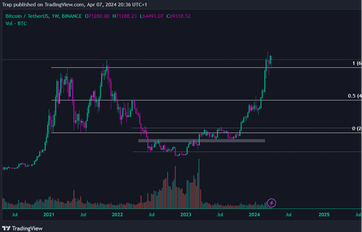
As all cryptocurrencies are influenced by Bitcoin’s performance, it is crucial that we take note of BTC’s historical actions. Currently BTC is sitting near its all time high after having surpassed the previous peak (due to its ETF being passed) and breaking previous resistance marks. This means that it is a really strong time for the cryptocurrency market as we enter a bull run.
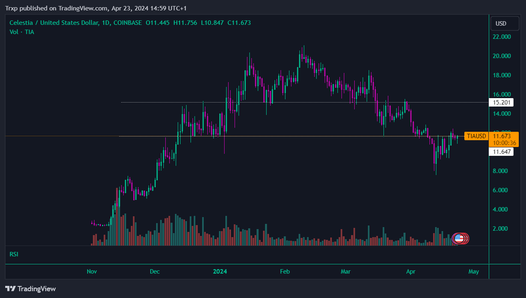
Final Thesis
As a popular coin among Crypto-Twitter natives, Celestia has the potential to grow exponentially like leaders of other narratives. Twitter showcases this mounting support for the idea and the coin (See below for examples). Therefore, TIA acts as an intriguing protocol, attracting the attention of retail investors and Web3 enthusiasts.

Source: @crypto_haku and @0xSantosia on Twitter
When we look at TIA’s chart, it is apparent that its performance recently has not been as good as Bitcoin’s. We can see a steep incline around December when the modular narrative was performing well and still relatively new. After that, there is evident support at the underlined marks (about $12) and resistance at around $15.40. In the future, it is a characteristic of a Bull run that strong narratives return to popularity. It is likely the modular narrative returns to a leading narrative within crypto and with Celestia as the front runner for it, TIA’s price should increase.
60
Ethereum: the future of finance?
BY Hugo okada
61
""I went around the world, explored many crypto projects, and finally realised that they were all too concerned about specific applications and not being sufficiently general — hence the birth of Ethereum, which has been taking up my life ever since." — Vitalik Buterin. [1]
Ether-Exciting Beginnings
Despite growing up in communist Russia, the founder of Ethereum, Vitalik Buterin, became the ultimate capitalist. Amusingly, Buterin claims his thirst for decentralisation stemmed from World of Warcraft, an online role-playing game. After Buterin’s "beloved warlock's Siphon Life spell" was nerfed, he explains that “on that day I realised what horrors centralised services can bring.” [2] These anecdotes of Buterin playing video games may give the wrong impression of the child genius. At age 7 he could recite more than 100 digits of pi, at 17 he co—founded Bitcoin Magazine, and at 19 he published the Ethereum white paper, a document detailing the technical information regarding Ethereum.[3] One year later he received the Thiel Fellowship, a $100,000 grant for young people to pursue their passion outside of academia.[4] This prompted Buterin to drop out of Waterloo University and pursue Ethereum full-time, catalysing his journey to becoming the world’s youngest cryptocurrency billionaire at 27.
A Troubled Fellowship
We have touched on Vitalik Buterin, Ethereum’s figurehead, but other masterminds are also behind the world’s second-largest blockchain. Blockchains, such as Ethereum and Bitcoin, are decentralised digital public ledgers that record transactions across many computers. Buterin’s seven fellow co-founders include Mihai Alisie, Anthony Di Iorio, Gavin Wood, Jeffery Wilcke, Joseph Lubin, Amir Chetrit, and perhaps most notably, Charles Hoskinson. Creative disputes between Hoskinson and Buterin saw Hoskinson abandon Ethereum in 2014; Hoskinson wanted Ethereum to be a for-profit organisation like Google, whereas Buterin envisioned today’s reality — a non-profit open ecosystem.
Figure 1: In China, Vitalik is referred to as V神— the V God. Despite it being a humorous nickname, it illustrates the respect many have for the founder of Ethereum.[5]

Interestingly, Hoskinson and Wood went on to start rival blockchains, Cardano and Polkadot respectively, both of which lie within the 15 largest cryptocurrencies by market capitalisation (the number of coins in circulation multiplied by the current market price). The other co—founders have focused their attention on other industries. Buterin compares the founders of Ethereum to JRR Tolkien's ‘Fellowship of the Ring’, where the protagonists part ways in the end.
Figure 3: Initially, co-founder Charles Hoskinson (above) appointed himself as CEO — a redundant title in the eyes of Buterin, who joked the designation should be C-3PO, a droid from Star Wars.[6]
10
Stumbling Blocks
Naturally, like any startup, there were ups and downs. In 2016, just one year after its launch, Ethereum experienced the “DAO hack”, (DAO stands for ‘decentralised autonomous organisation’, a form of legal structure without unilateral power where token holders can vote on matters). Hackers located errors in the DAO coding and stole around $50 million worth of Ether. The hack divided Ethereum developers. The majority wanted to create a new Ethereum chain, rectifying its errors by hacking the hacker, while the other camp took the “code is law” approach.
The dilemma occurred because the founders stepped in and prevented further damage. Ethereum Classic’s ideology is grounded in the blockchain remaining immutable and unaltered. As a result, two projects came out of the mess: today’s Ethereum chain, and the Ethereum Classic chain which was hacked.[7] To this day, Ethereum Classic actively condemns most blockchains, especially Ethereum, for compromising the central tenet of blockchain — decentralisation.
62
Your paragraph text
They were all huge personalities, huge egos, some more than others.” — Camila Russo.[8]
Although they have very similar names, they greatly differ. Ethereum Classic has a supply limit and adopts the proof of work consensus mechanism, unlike Ethereum, which has an unlimited supply and uses proof of stake (explained later).

Figure 4: The two chains of Ethereum post-DAO fork.[9]
Real-World Utility
Unlike Bitcoin, Ether, the token of the Ethereum blockchain, was not invented as an alternative to fiat currency (this is not to say Ether does not hold tremendous value. For instance, $28,985,486 worth of Ether aided the Ukraine-Russia conflict). Fiat currency is a government-issued currency that is not backed by a physical commodity. Ether was primarily intended to act as the currency for building and deploying smart contracts. Smart contracts are self-executing programmes which automate the actions required in the contract, therefore automating transactions without third-party intermediaries. It is fully immutable, except for the developer. All decentralised applications (dApps) are built using smart contracts. For example, Uniswap, a decentralised exchange built on Ethereum which allows the trade of digital assets.
Bitcoin and Ethereum are both Layer 1s, a base blockchain which provides the basic infrastructure and security, therefore allowing the potential for Layer 2s to be built on top of them. For example, the Ethereum Virtual Machine (EVM), is an imperative piece of Ethereum’s infrastructure. The EVM is a piece of software which executes smart contracts and manages gas fees (the cost of a transaction), among other functions, while computing the state of the network after each block is added to the chain.
Despite the fantastic infrastructure Ethereum provides, scalability issues have come to light — namely, only being able to handle around 15 transactions per second, compared to Visa's 24,000.[10]
Many argue that Solana will upend the value of Ether, as Solana can handle more than 2,000 transactions per second. Moreover, E-commerce platforms such as Shopify are producing a Solana payment system in partnership with Mastercard,[11] while Visa are working to integrate a Solana blockchain with merchant acquirers Worldpay and Nuvei.[12]
Fortunately for Ethereum, Layer-2 rollups have risen to the challenge of scalability. One of the most efficient and scalable rollups is Arbitrum, which provides up to 40,000 transactions per second at low fees off-chain, while still leveraging the security of the Ethereum chain.[13] Rollups essentially group transactions and submit them together to the Ethereum mainnet. There are two types of rollups, Zero-Knowledge (ZK) and Optimistic. As the name ‘Optimistic’ suggests, the rollup is assumed to be fully functioning and, if questioned, then validators must verify that transactions are correct (which can often take a matter of days). A faster technology are ZK-rollups, which use a cryptographic technique where one party can verify the statement without revealing the information of the statement. Due to the lack of information disclosed to the mainnet, it lies virtually impenetrable to current hackers.
Overall, Ethereum is favoured as a Layer1 over Bitcoin due to its superior programmability and its high level of security, meaning it is the bedrock of decentralised finance (DeFi).
“Ultimately the goal of crypto is not to play games with millions.”
— Vitalik Buterin [14]
63
Green Ethereum’s Proof-of-Stake Pivot
The public rightly draws comparisons between the traditional banking system and the blockchain industry. The annual electricity usage of cryptocurrency surpasses the usage of many individual countries. For instance, the White House found that cryptocurrencies contributed 0.4% — 0.9% of the global annual electricity usage in 2022,[15] while researchers from the University of Cambridge calculated that Bitcoin’s carbon dioxide emissions exceeded Cambodia's.[16] However, the emissions are predominantly due to Bitcoin’s proof of work consensus mechanism (PoW).
There are two main consensus mechanisms (a process in which validators reach a consensus that the activity on the chain is ‘legitimate’), proof of work (PoW) and proof of stake (PoS); they verify new transactions that are added to the blockchain while eradicating the need third-party intermediaries such as banks. Bitcoin is the quintessential PoW blockchain. It uses miners, which are network participants, to verify new data anonymously by solving arbitrary mathematical puzzles to ensure nobody games the system. The first miner to find the mathematical solution adds a new block of data to the blockchain, gaining a reward of the respective cryptocurrency (for Bitcoin, it is 6.25 BTC per block).[17] The issue is that PoW is a ‘race’ between miners. Mining necessitates huge computational power, resulting in high electricity use and, thus, emissions. Moreover, the more miners there are, the more challenging the mathematical puzzles become. This is done to standardise the number of blocks per unit of time – however, this also exacerbates emissions.
In 2020, Visa, Mastercard, and American Express processed 310 billion credit card payment transactions, compared to Ethereum and Bitcoin’s combined 460 million on-chain transactions. Yet, the three traditional financial services consumed less than 1% of the electricity the two largest blockchains did.
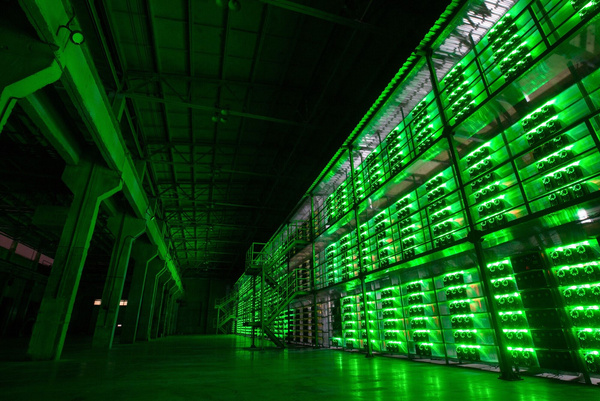
Figure 5: Russia’s largest Bitcoin mine.[18]
Since the Merge in September 2022, which saw the switch from PoW to PoS, Ethereum has become faster and far more energy efficient.[19] PoS does not require miners to solve complex mathematical puzzles. Instead, participants stake their Ether, putting up their tokens as collateral to validate transactions and create a new block. Validators must stake a minimum of 32 Ether, which is currently over £70,000; the more validators stake the more likely they are to verify a new block, thus earning a “base reward” of Ether.[20] To put it simply, owners of Ether will put their tokens forward, for a chance to be selected to validate a transaction and gain monetary value.
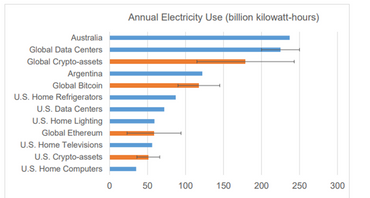
Figure 6: Compares the annual electricity use of examples shown above, using best estimates for cryptocurrency assets (as of August 2022).[22]
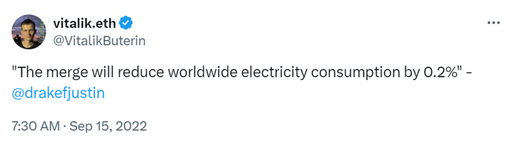
Figure 7: From Vitalik Buterin’s X account, explaining the sustainability of Ethereum after the Merge.[23]
64
A Bullish Blockchain
Like any hyper-successful venture (except for $WIF, a dog meme coin, currently at $2bn market cap), Ethereum provides real-world utility. As mentioned before, like Bitcoin, Ether is an alternative to fiat currency, but Buterin had a further vision, that Ethereum would be a platform allowing the development of dApps. dApps make redundant third-party intermediaries, meaning value is exchanged directly between the consumer and supplier. The consensus is that Ethereum will ultimately tackle global inequities, by undermining multinational conglomerates such as Uber, Facebook, and Amazon, but there is a lot of work to do before then.
Moreover, after the unrivalled success of the Bitcoin ETF, a hugely bullish narrative surrounds cryptocurrency. The fantastic growth potential of Ethereum is evident. Recent reports explain how Hong Kong and American firms are racing to roll out the Ethereum Spot ETF, making Ether a highly viable asset for not only the general population, but also institutional investment, offering an alternative to regular equities and bonds.[24] To put it into context, BlackRock’s Bitcoin ETF reached $10bn faster than any US ETF in history. This is likely to be mirrored by Ethereum, which arguably has greater growth potential than Bitcoin due to its smaller market cap.[25]
Tokens of Trepidation: The Risks of Ethereum
While much of the public claim cryptocurrencies are a scam, Ethereum itself is incredibly safe. It is the Layer 2s which build on the Ethereum network that produce unreliability. Layer 2s such as Optimism haphazardly use Solidity, Ethereum’s coding language, producing code vulnerable to cyberattacks. For instance, in May 2023, Optimism lost $20 million in a horrendously executed airdrop.[26] An airdrop is a common marketing strategy where tokens are randomly transferred to holders of the respective cryptocurrency (the hacker amusingly sold his Optimism for Ether and sent $1 million to Buterin).
In terms of the Ethereum blockchain, validators play an invaluable role in the PoS blockchain, keeping track of the transaction history and permitting new blocks.[27] But how does Ethereum ensure these random individuals will act benevolently and in the best interest of the platform?
Well, Ethereum uses slashing. Slashing is a fine imposed on validators that break protocol, taking a minimum of 1 Eth staked. Although these complexities may seem intimidating for those unaccustomed to cryptocurrencies, only 0.04% of Ethereum validators have been slashed since 2020.
When buying cryptocurrencies, novices typically use multi-asset brokerages, such as Etoro, for ease, but these companies demand large transaction fees. Fortunately, wallets are far more cost-efficient and use unfathomably secure passwords. A typical wallet uses a sequence of either 12 or 24 random and unrecoverable English words; the probability of guessing the password is 2048^12 or 2048^24 respectively, so it is best to keep it safe. The random words derive your private key, essentially a sequence of letters and numbers which permit access to transfer funds in and out of your wallet. The current risk surrounding your wallet is not hackers guessing your private key, but accessing it through phishing or spoofing scams, these account for 55% of all successful cryptocurrency cyber-attacks.[28] Cyberattacks occur to hot wallets, which are online wallets. Hot wallets are commonly used because they are straightforward, as you can connect them directly to your Apple or Google Pay. Intuitively the solution to avoiding cyberattacks are cold wallets, these are offline hardware, printed, or written recordings of your private key. Cold wallets are undoubtedly the safest but most costly method to secure your funds.
Since 2021, over 46,000 people have lost more than $1 billion in cryptocurrency scams, and 38% of hacks were on the Ethereum network.[29]
65
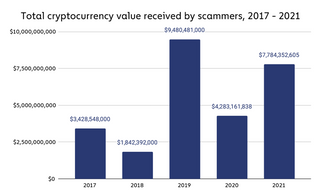
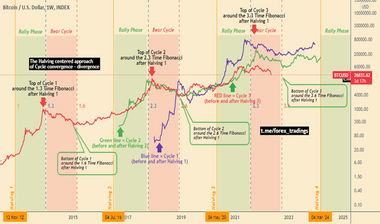
Figure 8: Shows the monetary value of cryptocurrencies stolen from 2017-2021.[30]
Figure 10: Shows the strong positive correlation between halving events and bull runs.[34]
Buterin is constantly evolving Ethereum, implementing frequent updates, which improve the efficiency of the blockchain. When discussing the future of Ethereum, the elephant in the room is scalability (or lack thereof). However, the development of ZK and Optimistic rollups are extremely bullish, they decrease gas fees and speed up transactions, addressing the previous criticisms of Ethereum. Moreover, the recent Dencun upgrade reduces the cost of Layer-2 rollups.[31] This is done by integrating ‘blobs’ into the network. These temporarily store information on the network instead of indefinitely, therefore decreasing the operational costs of rollups.
On the contrary, because the talk surrounding Central Bank Digital Currencies (CNBCs) and the of hyperinflation of many currencies (for example, the Bolivar Souverain, Sudanese Pound, and the Argentinian Peso), people are and will continue to be driven away from fiat currencies. As a result, cryptocurrencies are becoming integrated into the macroeconomics of nations. In fact, because of Argentina’s annual inflation soaring to 211.4% in 2023, Bitcoin has been introduced as an official currency, with 1/3 of Argentinians using cryptocurrencies daily.[35]
So, how does Bitcoin’s utility affect Ethereum; could Ether integrate itself into the macroeconomics of a nation, as Bitcoin has? Well, many dismiss the utility of Ether because of its expandable supply (unlike Bitcoin), so people assume Ether is inflationary and thus a poor hedge against inflation. However, this is untrue. Ether is burnt when transactions occur (a feature changed since the Merge). As a result, in periods of high network activity, Ether is deflationary, while in periods of low network activity, it is inflationary, therefore having the potential of becoming the world’s first deflationary currency. In times of economic downfall, the public will increasingly turn to cryptocurrencies, particularly Ether, to fight inflation.
Macroeconomic Analysis
The general macroeconomics of the cryptocurrency market is exceedingly healthy, nearing all-time highs, as illustrated by Figure 10. In addition, with the Bitcoin halving on the horizon (a quadrennial process in which the mining reward is split in half to counteract inflation), and the expected approval of an Ethereum Spot, a further influx of institutional investors are expected.
It should be noted that the regulation of cryptocurrencies is dependent on political outcomes. For example, Biden desires to implement a 30% tax of Bitcoin mining,[32] and has used cryptocurrencies as a scapegoat for illicit financing.[33] However, these outdated views should be unsurprising, given his calamitous tenure as US president (the cryptocurrency community also mocks the president, with $boden, a Joe Biden meme coin recently exceeding $700,000,000 in market capitalisation). Also, in the short-term, Bitcoin may see a correction of around 20%, as investors rotate to altcoins. This is natural.
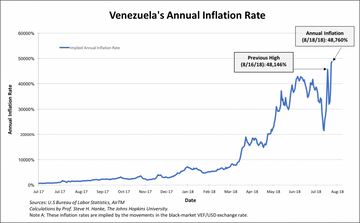
Figure 11: Rates of Venezuelan hyperinflation from July 2017-August 2018.
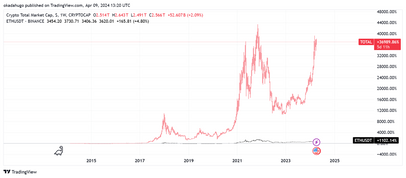
66
Figure 12: Total market capitalisation of the cryptocurrency market.
As illustrated by Figures 13 and 14, since Bitcoin’s momentous rally surpassed its all-time high, Bitcoin has consolidated at its all-time high. This is due to the BlackRock ETF announcement, which has given Bitcoin newly recognised legitimacy, and in-turn facilitated further mainstream investment in Alt coin, including Ether. However, Ether has yet to successfully break its all-time high of $4,379, remaining within the range of $3300 and $4000, as shown in Figure 13. Now, why is Ether underperforming? Well, Bitcoin drives the market, so historically, Ether’s performance lags Bitcoin. In the 2021 bull run, once Bitcoin fell in value, Ethereum far outperformed the market leader, and similar is to be expected in the current bull market. With Bitcoin consolidating at its all-time high of over $70,000 (as shown in Figure 11), the entire cryptocurrency market looks incredibly healthy, including Ether. This is not to say that in the short-term the market will not see a correction, but as previously explained, Ethereum has unparalleled fundamentals. With bullish market conditions, Ether is in line to inevitably break the resistance.
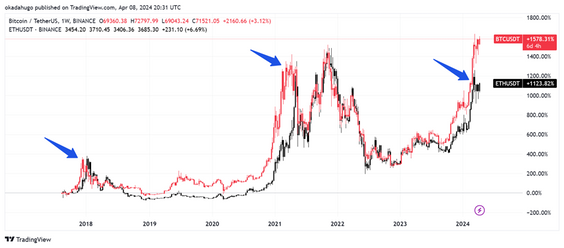
Figure 13: The blue arrows show when Ether’s performance (in red) has lagged Bitcoin (in black).
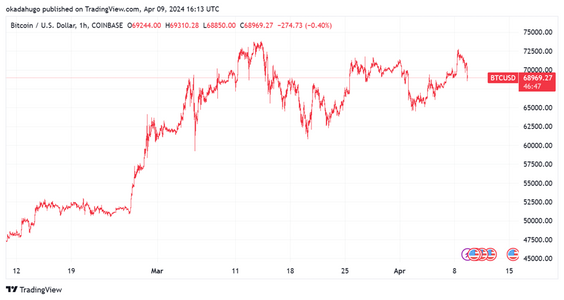
Figure 14: Shows the recent performance of Bitcoin, 12th February 2024—9th April 2024.
Conclusion
The overall thesis for Ether is clear; Ethereum is the cornerstone of blockchain technology with its highly accessible and secure infrastructure, and with the ETH ETF near, the institutional investment will propel Ether into the stratosphere. Additionally, Ether has yet to seriously rally in the current bull market, meaning Ether is a fantastic short and long-term investment.
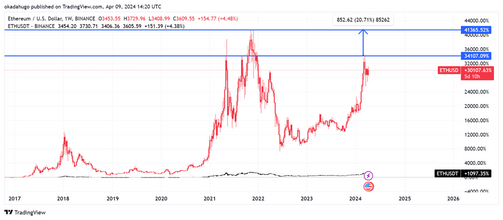
67
Figure 15: The blue arrows show when Ether’s (in red) performance has lagged Bitcoin (in black).
6
References
6
Reference List
Jake References --------
- Cho, J. B., Serneels, S., & Matteson, D. S. (2023). Non-Fungible Token Transactions: Data and Challenges. Data Science in Science, 2(1).
- “Fashion’s Digital Future.” SHOWstudio, 27 Oct. 2020, www.showstudio.com/projects/fashions-digital-future.
- Holtz, Peter. “Does Postmodernism Really Entail a Disregard for the Truth? Similarities and Differences in Postmodern and Critical Rationalist Conceptualizations of Truth, Progress, and Empirical Research Methods.” Frontiers in psychology vol. 11 545959. 17 Sep. 2020,
- Vierzig, Angelika. “Anthropomorphic Stelae of the 4th and 3rd Millennia Between the Caucasus and the Atlantic Ocean.” Proceedings of the Prehistoric Society 86 (2020): 111–137. Web.
William References --------
- Desmond, Vincent. “The Long-Lasting Impact of Nfts on Art in Nigeria.” ArtReview RSS, 19 Feb. 2024, artreview.com/the-long-lasting-impact-of-nfts-on-art-in-nigeria/.
- Studebaker, Lauren. “Expanding the Metaverse.” Sothebys.Com, 7 Aug. 2023, www.sothebys.com/en/articles/expanding-the-metaverse.
Piper References --------
- [1] “Arbitration.” Cornell Law School Legal Information Institute.
- [2] Handagama, Sandali. “Crypto Exchange Coinbase Faces Class Action Lawsuit Over Alleged Collapses in Security.” CoinDesk, 11 May, 2023.
- [3] Ronald Mann, Justices rule lower courts must put trial proceedings on hold during arbitration appeal, SCOTUSblog.
- United States District Court for the Northern District of Georgia Atlanta Division. George Kattula v. Coinbase, Inc. 2022.
Sean References --------
- [1] Kunert, Paul. “UK MoD’s Capita-Run Recruitment Portal Support Offline.” The Register, 24 Mar. 2022.
- [2] Rosen, Liana W., and Paul Tierno. Terrorist Financing: Hamas and Cryptocurrency Fundraising. Congressional Research Service, 2023.
- [3] Chainalysis Team. “2024 Crypto Crime Trends from Chainalysis.” Chainalysis, 18 Jan. 2024.
- [4] Grauer, Kim, et al. The 2023 Crypto Crime Report. Chainalysis, Feb. 2023.
- [5] Lynch, Sarah N., and Chris Prentice. “FBI to Form Digital Currency Unit, Justice Dept Taps New Crypto Czar.” Reuters, 17 Feb. 2022.
Piper References --------
- [1] Madden, Piper. “Coinbase In Court: A Legal Battle For Privacy.” St Andrews Blockchain Society, 9 Apr. 2024
- [2] De, Nikhilesh. “Coinbase Loses Most of Motion to Dismiss SEC Lawsuit.” CoinDesk, 27 Mar. 2024
- [3] De, Nikhilesh. “What a Judge Said About the SEC’s Suit Against Coinbase.” CoinDesk,Apr. 2, 2024,
- [4] United States District Court Southern District of New York. SEC v. Terraform Labs PTE.
- [5] Bultman, Matthew. “Crypto Firms Take SEC Fight to Texas, With Eye on Supreme Court.” Bloomberg Law, 5 Apr. 2024,
- [6] Smith, David. “How Trump reshaped the fifth circuit to become the ‘most extreme’ US court.” The Guardian, 15 Nov. 2021.
- [7] Frankel, Allison. “Judge in Coinbase case endorses SEC’s crypto regulation-by-enforcement strategy.” Reuters, 27 Mar. 2024.
- Mann, Ronald. “Justices seem to resolve Dogecoin arbitration dispute during argument.” SCOTUS Blog, 9 Apr. 2024.
- Ltd, and Do Hyeong Kwon. Jed S. Rakoff, U.S.D.J., 2023.
James References --------
- [1] Statista. “TV Viewership of the Super Bowl in the United States from 1990 to 2024.” Statista, 2018
- Florio, Mike. “Global Super Bowl Audience Increases to 62.5 Million (Which Really Isn’t All That Impressive).” NBC Sports, 6 Mar. 2024.
- [2] Statista. “Average Cost of a 30-Second Super Bowl TV Commercial in the United States from 2002 to 2024.” Statista, 2019.
- [3]Adgate, Brad. “The Crypto Bowl Will Not Be Returning for Super Bowl LVII.” Forbes, 24 Jan. 2023.
- [4] Faverio, Michelle, and Olivia Sidoti. “Majority of Americans Aren’t Confident in the Safety and Reliability of Cryptocurrency.” Pew Research Center, 10 Apr. 2023.
- [5] Adgate, “The Crypto Bowl Will Not Be Returning for Super Bowl LVII.”
- [6] Wheless, Erika. “Inside Crypto Exchange FTX’s Push to Become a Household Name.” Ad Age, 13 Dec. 2021.
- [7] Coinbase. “Everyone Wins at Super Bowl LVI — WAGMI!” Coinbase, 13 Feb. 2022.
- [8] Newton, Ksenia. “The Most Talked-about Super Bowl Ads of the Last 5 Years.” Brandwatch, 1 Feb. 2024.
- [9] McDade, Aaron. “A Look at the Companies behind the Pricey “Crypto Bowl” Ads, Then vs. Now, as Super Bowl LVII Approaches.” Business Insider.
- [10] McDade, “A Look at the Companies behind the Pricey “Crypto Bowl” Ads, Then vs. Now, as Super Bowl LVII Approaches.”
69
James References Continued --------
- [11] Chittum, Morgan. “The CEO of Coinbase Says the Exchange Will See Revenue Plunge at Least 50% in 2022 as Turmoil Weighs on Crypto Markets.” Markets Insider, 8 Dec. 2022.
- [12] Sweet, Ken, and Mae Anderson. “Year after “Crypto Bowl,” Crypto Ads Vanish from Big Game.” The Hill, 10 Feb. 2023.
- [13] Adgate, “The Crypto Bowl Will Not Be Returning for Super Bowl LVII.”
- [14] Shakir, Umar. “Fox’s Super Bowl LVII Ads Won’t Include Any Crypto Companies.” The Verge, 6 Feb. 2023.
- [15] Hsu, Tiffany. “Prepare Yourself for This Weekend’s “Crypto Bowl.”” The New York Times, 11 Feb. 2022.
- [16] Milmo, Dan. “How Binance Played a Key Role as FTX Collapse Unfolded.” The Guardian, 11 Nov. 2022.
- [17] Coffee, Patrick. “Crypto Brands Reposition Themselves in Wake of FTX and Market Tumble.” Wall Street Journal, 7 Feb. 2023.
- [18] WebsCrypto Team. “Coinbase Takes Full Page Ad in WSJ: “Trust Us.”” WebsCrypto, 18 Nov. 2022.
- [19] Adgate, “The Crypto Bowl Will Not Be Returning for Super Bowl LVII.”
- [20] Browne, Tanaya and Macheel,Ryan. “Bitcoin Rises to Another Record, Ether Breaks through $4,000.” CNBC, 11 Mar. 2024.
- [21] O’Reilly, Lara, et al. “Crypto Firms like Binance, Grayscale, and OKX Are Pouring Money into Marketing to Regain Trust and Save Their Companies from the Fallout of the FTX Implosion.” Business Insider, 1 Dec. 2022.
Finn References --------
- Foppolo, Gaël. “Elliptic-Curve Cryptography (ECC).” Medium, 3 Sept. 2018.
- GeeksforGeeks. “Euler’s Totient Function.” GeeksforGeeks, 5 June 2015.
- Kinney, Bill. “Extended Euclidean Algorithm: GCD Is a Linear Combination.” Www.youtube.com, 9 Jan. 2023.
- [1] Knutson, Hans. “What Is the Math behind Elliptic Curve Cryptography?” Hacker Noon, Hacker Noon, 7 Apr. 2018.
- Sullivan, Nick. “A (Relatively Easy to Understand) Primer on Elliptic Curve Cryptography.” The Cloudflare Blog, 24 Oct. 2013.
Osian References --------
- [1] “NIH Data Book.” Report.nih.gov.
- [2] “Crunch Foundation.”
- [3] “Funding (Sponsorship) Bias.” The Embassy of Good Science, 4 Oct. 2021.
- [4] World Intellectual Property Organization. The Global Publishing Industry in 2020. WIPO, 2022.
- [5] Nagaraj, Abhishek, et al. Improving Data Access Democratizes and Diversifies Science. no. 38, Sept. 2020, pp. 23490–98.
- [6] “206 — Decentralized Science | Brian Armstrong & Patrick Joyce.”
- [7] “Crunch Foundation.”
- [8] “WTF Is Quadratic Funding?”
- [9] “ResearchHub | Open Science Community.” ResearchHub.
- [10] “ResearchHub | Open Science Community.” ResearchHub.
- [11] Armstrong, Brian. “Ideas on How to Improve Scientific Research.” Medium, 13 Nov. 2023.
- [12] ibid
- [13] “W Airdrop Explained.” Wormhole, 6 Mar. 2024.
- [14] “Hubs | ResearchHub Docs.” Researchhub.com, 15 Dec. 2023.
- [15] More Ray Dalio Wisdom.
- [16] Cantor, Charles R. “Biotechnology in the 21st Century.” Trends in Biotechnology, vol. 18, no. 1, Jan. 2000, pp.6–7.
- [17] “Death Is Optional | Edge.org.” Edge.org, 2019.
- [18] “BILL GATES at IIT DELHI | BILL GATES Success Journey | Full Session.”
- [19] “Peter Thiel Has Invested Millions in Longevity Research. Here’s the Billionaire’s Antiaging Routine.” Yahoo News, 17 Nov. 2023.
- [20] “NewLimit | Extending Human Healthspan.”
- [21] “Molecule Protocol Home | a New Era of Drug Development.”
- [22] “ResearchHub | Open Science Community.” ResearchHub.
- [23] Selkis, Ryan. “Crypto Theses for 2024.” Messari.io, 2024.
- [24] Coinbase Wins Legal Battle over Secondary Crypto Sales. 6 Apr. 2024.
- [25] ResearchHubF. “We Are Pleased to Share That ResearchCoin $RSC Is Now Live on @Base . More Details on Addresses, Pools, and Bridges Can Be Found Later in This Thread. There Are 2 Important Reasons for Why This Is a Pivotal next Step for @ResearchHub and Our Community.” 8 Apr. 2024.
- [26] Beckman, Jeff. “Coinbase Statistics: 2023 Market Share, Profit Breakdown, & More.” The Tech Report, 28 Oct. 2023.
- [27] SANTOSO, DJOKO. “Depopulation and the Threat of Demographic Disaster.” Kompas.id, 27 Mar. 2024.
- [28] Salvo, Decrypt / Mat Di. “BlackRock CEO Larry Fink: Crypto Will ‘Transcend Any One Currency.’” Decrypt, 14 July 2023.
- [29] Braun, Helene. “BlackRock’s Fink Says an Ether ETF Is Possible Even If ETH Is a Security.” 27 Mar. 2024.
- [30] Selkis, Ryan. “Crypto Theses for 2024.” Messari.io, 2024.
- [31] Jon. “Peter Lynch: The Single Most Important Thing • Novel Investor.” Novel Investor, 26 Apr. 2017.
70
Parker References --------
- [1] Dayani, Rohit. “What Is Celestia? A Comprehensive Overview of the First Modular Blockchain.” Stakin, 31 Oct. 2023.
- [2] David, Okoya. Polygon Boosts Layer 2 Kit with Celestia Data Availability . 13 Dec. 2023,.
- [3] Dayani, Rohit.
Hugo References --------
- [1] “Home.” Ethereum.org.
- [2] Dailey, Natasha. “Vitalik Buterin Says He Created Ethereum after His Beloved World of Warcraft Character Was Hobbled by the Developers, Awakening Him to the ‘Horrors Centralized Services Can Bring.’” Markets.businessinsider.com, 5 Oct. 2021.
- [3] Dailey, Natasha.
- [4] Russell, Jon. “Join Ethereum Creator Vitalik Buterin at Our Blockchain Event on July 6.” TechCrunch, 23 Apr. 2018.
- [5] Lee, Henrique Centieiro & Bee. “8 Things You Didn’t Know about Vitalik Buterin & Ethereum!” Coinmonks, 19 June 2023.
- [6] Parkin, Darren. “IOG Announces Midnight - a New Blockchain to Protect Data and Safeguard Technology Freedoms.” CityAM, 18 Nov. 2022.
- [7] Hamacher, Adriana. “Who Are Ethereum’s Co-Founders and Where Are They Now?” Decrypt, 28 July 2020.
- [8] Kar, Ian. “The Developers behind Ethereum Are Hacking the Hacker That Hacked It.” Quartz, 21 June 2016.
- [9] McIntyre, Author Donald. “Ethereum Classic vs Ethereum 2.0, What Is the Difference?” Etherplan, 23 July 2019.
- [10] “Transactions per Second (TPS): The Complete Guide.” 21 Sept. 2023.
- [11] Labs, Solana. “Solana Pay Integrates with Shopify as New Payment Option to Transform Commerce.” Www.prnewswire.com, 23 Aug. 2023.
- [12] VISA. “Visa Expands Stablecoin Settlement Capabilities to Merchant Acquirers.” Usa.visa.com, 9 May 2023.
- [13] Purushotham, Abhishek. “Exploring Cross-Chain Solutions: How to Bridge into Arbitrum.” AXELAR, Sept. 27AD.
- [14] Chow, Andrew R. “The Man behind Ethereum Is Worried about Crypto’s Future.” Time, 18 Mar. 2022.
- [15] CLIMATE and ENERGY IMPLICATIONS of CRYPTO-ASSETS in the UNITED STATES. 2022.
- [16] Coney, Philippa. “Ethereum’s Climate Impact: A Contemporary and Historical Perspective - News & Insight.” Cambridge Judge Business School, 1 Dec. 2023.
- [17] Lielacher, Alex. “What Is a Block Reward?” Crypto.news, 18 Aug. 2022.
- [18] Rudakov, Andrey. Russia’s Largest Bitcoin Mine Turns Water into Cash. 24 Nov. 2019.
- [19] CLIMATE and ENERGY IMPLICATIONS of CRYPTO-ASSETS in the UNITED STATES. 2022.
- [20] “The Merge.” Ethereum.org, 24 Mar. 2024.
- [21] “Ethereum Staking.” Ethereum.org.
- [22] CLIMATE and ENERGY IMPLICATIONS of CRYPTO-ASSETS in the UNITED STATES. 2022.
- [23] Buterin, Vitalik. “‘The Merge Will Reduce Worldwide Electricity Consumption by 0.2%’ - .” X, 9 Autumn 2022.
- [24] Devitt, Conor. “Firms in Hong Kong Looking to Issue Ethereum (ETH) ETFs before US Gets Approval: Report.” The Daily Hodl, 12 Mar. 2024.
- [25] Schmitt, Will. “Bitcoin Rally Pushes BlackRock ETF over $10bn in Record Time.” Financial Times, 10 Mar. 2024.
- [26] Elliott, Stacy. “Optimism Hacker Returns 17 Million Tokens after Airdrop Blunder.” Decrypt, 10 June 2022.
- [27] Elliott, Stacy.
- [28] McNeal, Amy. “10 Facts about Cryptocurrency Phishing & Other Crypto Risks That You Need to Know.” Graphus, 10 Mar. 2022.
- [29] Fletcher, Emma. “Reports Show Scammers Cashing in on Crypto Craze.” Federal Trade Commission, 3 June 2022.
- [30] Grigg, Gurvais. “Crypto Crime Has Hit Main Street. Here’s How Local Law Enforcement Can Take Action.” Chainalysis, 13 Dec. 2022.
- [31] Joshua, Adekunle. “Ethereum Price All Set to Surge before Dencun Upgrade on 13 March: All about the Possible Rally.” Voice of Crypto, 9 Feb. 2024.
- [32] Reguerra, Ezra. “Biden Resurrects 30% Crypto Mining Tax in New Budget Proposal.” Cointelegraph, 12 Mar. 2024.
- [33] Wright, Joanna. “Why GOP Senators Say Biden Is ‘Scapegoating’ Crypto on Illicit Finance.” DL News, 9 Apr. 2024.
- [34] atal_Cryptosignals. “#BTC #Bitcoin Halving Cycles for INDEX:BTCUSD by Atal_Cryptosignals.” TradingView, 12 May 2022.
- [35] Rey, Debora. “Argentina’s Annual Inflation Soars to 211.4%, the Highest in 32 Years.” AP News, 11 Jan. 2024.
Lauren References --------
- [1] Amure, Tobi. “What Is XRP?” Investopedia, 2023.
- [2] XRP Ledger. “History.” Xrpl.org, 2024.
- [3] Forbes. “Jed McCaleb.” Forbes, 2024.
- [4] Investopedia Team. “Mt. Gox.” Investopedia, 2019.
- [5] Steves, Rick. “Ripple - Stellar Rivalry Grows, but Why Did Jed McCaleb Leave Ripple?” FinanceFeeds, 2022.
- [6] Miller, Bob. “Arthur Britto: Is Ripple’s Faceless Co-Founder Even Real?” Daily Coin, 2023.
- [7] Castillo, Michael del. “Ripple’s Trillion-Dollar Man.” Forbes, 2018.
- [8] Castillo, Michael del. “Ripple’s Trillion-Dollar Man.” Forbes, 2018.
- [9] Amure, Tobi. “What Is XRP?” Investopedia, 2023.
- [10] Amure, Tobi. “What Is XRP?” Investopedia, 2023,.
- [11] G., Michael William. “Which Banks Use Ripple XRP.” Watcher Guru, 8 Aug. 2023.
- [12] Sharma, Rakesh. “Ripple Ecosystem: What Is the Role of XRP?” Investopedia, 2023.
71
Lauren References Continued --------
- [13] Daugherty, Greg. “Understanding Real-Time Gross Settlement (RTGS).” Investopedia, 2024.
- [15] Investopedia Team. “Consensus Mechanism (Cryptocurrency).” Investopedia, 2023.
- [16] Kaur, Guneet. “Cointelegraph Bitcoin & Ethereum Blockchain News.” Cointelegraph, 2023.
- [17] Drylewski, Alex. “Ripple Effects: Developments Following Groundbreaking Decision in SEC v. Ripple Labs.” Reuters, 2023.
- [18] Kaur, Guneet. “Cointelegraph Bitcoin & Ethereum Blockchain News.” Cointelegraph, 2023.
- [19] Protos. “Here’s Why the SEC Never Classified Ether as a Security.” Protos, 2023.
- [20] Kaur, Guneet. “Cointelegraph Bitcoin & Ethereum Blockchain News.” Cointelegraph, 2023.
- [21] McGimpsey, Patrick. “XRP Price Prediction: Will Ripple Make Waves in 2024?” Forbes Advisor Australia, 2024.
- [23] Mason, Bob. “XRP News: Ongoing Investigation Threatens SEC Plans to Appeal Court Ruling.” FX Empire, 2024.
- [24] CoinMarketCap. “XRP USD (XRP-USD) Price, Value, News & History - Yahoo Finance.” Yahoo Finance, 2024.
- [25] Basulto, Dominic. “Bitcoin ETF Trading Volume Tripled in March. Will That Trend Continue in April?” USA TODAY, 2024.
- [26] Reiff, Nathan. “Bitcoin vs. Ripple Labs: What’s the Difference?” Investopedia, 2023.
- [27] Chen, George. “CryptoSpend Blog | a Historical Recap of Past Crypto Bull and Bear Markets.” Wayex, 2024.
- [28] Crypto Daily. “Here’s Why Ripple (XRP) Investors Are Selling and Moving towards This New GameFi Token.” Crypto Daily, 2024.
- [29] McGimpsey, Patrick. “XRP Price Prediction: Will Ripple Make Waves in 2024?” Forbes Advisor Australia, 2024.
- [30] Keating, Rob. “How Long Does a Bank Transfer Take?” GoCardless, 2022.
- [31] NFTPLANETARIUM. “Dubai’s Pioneering Move: Revolutionizing Oil Trade with XRP.” Medium, 2023.
- [32] Vardai, Zoltan. “XRP Approved by Dubai’s Financial Services Authority.” Yahoo Finance, 2023.
- [33] Fathi, Abdelaziz. “Ripple Co-Founder Hacked for 213 Million XRP Worth $113 Million.” FinanceFeeds, 2024.
- [34] Fulton, RJ. “3 Charts That Show How the Crypto Bull Market Is Just Getting Started.” Yahoo Finance, 2024.
- [35] CoinMarketCap. “XRP USD (XRP-USD) Price, Value, News & History - Yahoo Finance.” Yahoo Finance, 2024
Zara References --------
- [1] Chainlink. (2021).
- [2] Nikbakht, E., Baker, H. K., & Smith, S. S. (2021) *The Emerald Handbook of Blockchain for Business*, Emerald Publishing Limited.
- [3] Anadiotis, G. (2019) 'Chainlink launches Mainnet to get data in and out of Ethereum smart contracts', *ZDNet*, 30 May. Available at: https://www.zdnet.com/
- [4] Anadiotis, G. (2021) 'Chainlink 2.0 brings off-chain compute to blockchain oracles, promotes adoption of hybrid smart contracts', *ZDNet*, 15 April. Available at: https://www.zdnet.com/
- [5] Block Stories: The Chainlink Origin Story. (2021).
- [6] Breidenbach, L., et al. (2021) *Chainlink 2.0: The Next Steps in the Evolution of Decentralized Oracle Networks*. Available at: https://research.chain.link/whitepaper_v2.pdf
- [7] Orcutt, M. (2018) 'Blockchain smart contracts are finally good for something in the real world', *MIT Technology Review*. Available at: https://www.technologyreview.com/
- [8] Sharma, D., Pant, D., & Kumar, A. (2023) 'Cryptocurrency: An Overview of its History, Technology and Future Prospects', *International Journal of Advanced Research in Science, Communication and Technology*.
- [9] Pérez-Marco, R. (2016) 'Bitcoin and Decentralized Trust Protocols', *ArXiv*. Available at: https://consensus.app/papers/bitcoin-decentralized-trust-protocols-pérezmarco/8a6b898150bd5f72b12e647dd4dc69df/
- [10] Sakız, B., & Gencer, E. (2020) 'Cryptocurrencies, Blockchain Technology and Sustainability'. Available at: https://consensus.app/papers/cryptocurrencies-blockchain-technology-sustainability-sakız/d6099784afd15dc6b0df2baaaac238db/
- [11] Chen, Y. (2017) 'Blockchain Tokens and the Potential Democratization of Entrepreneurship and Innovation', *Stevens Institute of Technology - School of Business Research Paper Series*. Available at: https://consensus.app/papers/blockchain-tokens-potential-democratization-chen/6806baa980135ee6bfac5d480325f9c3/
- [12] Nabilou, H. (2019) 'How to Regulate Bitcoin? Decentralized Regulation for a Decentralized Cryptocurrency'. Available at: https://consensus.app/papers/regulate-bitcoin-decentralized-regulation-nabilou/25aeead30f5c55d69d5cddd62097f533/
- [13] Valdivia, W. et al. (2019) 'Compliance and Cryptocurrency', *International Journal of Regulatory Oversight*.
- [14] Dierksmeier, C., & Seele, P. (2018) 'Cryptocurrencies and Business Ethics', *Journal of Business Ethics*, vol. 152, pp. 1-14.
- [15] Xu, G. et al. (2018) 'The Challenge of Privacy and Security in Blockchain'.
- [16] Sarukkai, R. (2000) 'Link prediction and path analysis using Markov chains', *Comput. Networks*.
- [17] Ji, H., & Huang, C.-Y. (1998) 'Non-cooperative uplink power control in cellular radio systems', *Wireless Networks*.
- [18] Turner, C. E. (2012) 'The Early Nineteenth-Century Chain Testing Machines', *The International Journal for the History of Engineering & Technology*.
- [19] Medhat, A., et al. (2017) 'Service Function Chaining in Next Generation Networks: State of the Art and Research Challenges', *IEEE Communications Magazine*.
- [20] Ghimire, S., & Selvaraj, D. H. (2018) 'A Survey on Bitcoin Cryptocurrency and its Mining', *Proceedings of the 26th International Conference on Systems Engineering (ICSEng)*, pp. 1-6.
- [21] Drożdż, S., et al. (2019) 'Competition of noise and collectivity in global cryptocurrency trading: route to a self-contained market', *Chaos*, vol. 30, no. 2, 023122.
- [22] Saxena, R., et al. (2021) 'Bitcoin: A Digital Cryptocurrency', *Intelligent Systems Reference Library*.
- [23] Sharma, D., et
- [24] Shkurat, M., & Zavydovska, A. O. (2023) 'Study of the determinants affecting the mechanism of functioning of cryptocurrencies in the context of uncertainty of the global economy', Vìsnik Marìupolʹsʹkogo deržavnogo unìversitetu Serìâ Ekonomìka.
- [25] Shi, S. (2023) 'The relationship between cryptocurrencies and the stock market'.
- [26] Shkurat, M., & Zavydovska, A. O. (2023) 'Study of the determinants affecting the mechanism of functioning of cryptocurrencies in the context of uncertainty of the global economy', Vìsnik Marìupolʹsʹkogo deržavnogo unìversitetu Serìâ Ekonomìka.
72


THE COMMITTEE
Photo Credits: Caorline Vining
PREsident
FINN ANDERSON

I originally had the idea to create this society during a conversation with my older brother. It appeared clear to me that many were hesitant about various concepts relating to blockchain and cryptocurrencies at St Andrews. Web3 — an umbrella term for these concepts — was commonly associated with crime and financial insecurity, leaving many unaware of its true innovation. This club was my attempt to highlight these intricacies, both positive and negative.
My fascination with the industry started during lockdown in 2020. Paired with the humour of crypto-Twitter, I found Web3 to be an incredibly interesting consolidation of computer science, economics, mathematics, and history. I continued to explore Web3 throughout my undergrad, which led to my eventual role as an algorithmic trading writer for CoinGecko in 2023. Through this opportunity, I developed various trading strategies, spanning technical analysis and deep learning.
I am incredibly thankful for the seven founding committee members who were willing to create this society, let alone for the ten more who have formed our new committee. Joining a club focused on such a polarising industry can feel unsettling, especially considering the level of popular acceptance. But, if anything in this work appeals to you, even if you're unfamiliar with it, I highly encourage you to join the St Andrews Blockchain Society.
74
COLE KIEFER
vice president

Having an interest and background in traditional finance, I joined the Blockchain society due to the emerging ubiquity and innovation the technology provides. Rather than being an idle and skeptical spectator, I sought to deconstruct widespread presuppositions about blockchain and cryptocurrency mechanisms, and help St Andrews students learn to understand, adapt, and appreciate, especially as it becomes more prevalent and widespread in mainstream retail investing. Personally, I have a particular interest within the investing-realms of cryptocurrency, which has been continually reaffirmed with newly established ETFs, and the increasing global adoption of cryptocurrency as not only a medium of exchange, but a store of value. It has been an incredible experience learning and guiding fellow interested students in the society's inaugural year, and I look forward to seeing the growth and success the St Andrews Blockchain Club will experience with a great new committee in place for next year!
Editor-in-chief
James MAGLIOne

The main reason I joined STABS was because I have editorial experience and wanted to try my hand at journalism. I also wanted to learn about financial concepts through extracurriculars and found blockchain to be a more interesting, dynamic, and interdisciplinary field than traditional finance. While I was relatively new to blockchain at the start of the year, the STABS writing section was an enjoyable and effective way to learn about an exciting new topic and gain valuable writing experience along the way. As editor-in-chief, I had the pleasure of working with a talented team of writers, fostering an open-ended and collaborative environment. It was a lot of fun hearing about people's different backgrounds and interests, and finding where they could connect to blockchain. I would urge anyone who wants to gain writing experience to try their hand next year - no matter your writing ability or proficiency with Web3. We had an absolute blast making this magazine, and I hope you find it engaging and informative.
75

HEAD ENGINEER
KABIR BERGER

As the Head Engineer of The St. Andrews Blockchain Society, I discovered a passionate community committed to exploring and advancing blockchain technologies. My perspective on cryptocurrencies is profoundly influenced by my fascination with decentralization. I am captivated by blockchain’s potential to democratize financial systems and promote transparency, which I believe can lead to a more equitable world. Motivated by this, I focused on assembling a team of diligent and skilled individuals dedicated to furthering the society’s goal of blockchain education. We lead several cryptocurrency projects throughout the year, including a website platform to support our editorial and investment groups. It has been a privilege to collaborate with the Blockchain Society, and I am eager to see future enthusiasts who share our interest in crypto continue the legacy within St. Andrews.
head of fund
Osian guthrie

My interest in crypto began during lockdown in 2020. I managed to catch the bottom of the 2020-21 bull cycle and became obsessed with trading and rebalancing my portfolio, initially trading perpetual futures on Binance before heading on-chain. The nature of lockdown allowed me to really go deeper down the rabbit-hole. Crypto is at once a hotbed of innovation, the most inefficient market in the world, and a hilarious sitcom of crypto-Twitter characters, and is therefore one of the most exciting industries to explore, whether you’re interested in engineering, entrepreneurship, writing, art — just about anything. I have thoroughly enjoyed being involved with the STABS this year, both helping Cole manage the investment vertical as well as managing the society’s accounts. As incoming president, I hope to help foster its growth as well as continue to develop education and interest around blockchain throughout the university.
76
SECRETARY
BRUNO CECCOLINI

My passion for technology and experience working in the blockchain industry was the reason I decided to help Finn with the university's first blockchain society. Attending the Solana Breakpoint conference in 2022, I was exposed to many innovative projects, which sparked my interest in this exciting industry. As a computer science student, I was mainly drawn to the engineering side and contributed by helping develop the website, as well as holding technical workshops. I hope this society can continue to grow and provide open-minded students with valuable insights into the potential of blockchain technology.
HEalth and safety officer
JAKE BILL

I joined the Blockchain Society despite having very little (no) understanding of crypto and Web3. However, Finn, a master of persuasion, convinced me through his passion for the subject, breadth of knowledge, and determination to bring the society from 0 to 1 within a matter of months. And that he did— bringing together some of the most interesting and charismatic minds of St Andrews to create a future-proof society which will thrive long after we graduate.
77
Acknowledgements
The material in this publication has drawn on research from a diligent and ambitious group of students, spanning various degrees and all years of undergraduate studies. Every member of our writing, investing, and engineering groups produced a piece of work, often stretching their capabilities beyond their chosen subject area. Each section took various forms, constructed from weekly meetings starting back in the fall.
Conceiving the idea for this publication, Cole Kiefer was instrumental in the completion of the Financial Reports section, as he committed an inordinate amount of time to ensure each report was treated with the same level of attention. His knowledge of traditional finance and calm demeanour, alongside Osian Guthrie’s crypto-specific understanding, guided the members of the investing constituency through the assortment of complexities associated with Web3 economics. Bruno Ceccolini and Kabir Berger acted in tandem to completely transform the digital presence of the St Andrews Blockchain Society. Bruno’s resolve and perpetual attention led to the maintenance of our website and the groundwork for this publication. The development of our website is due to the independent and fantastic work of Kabir Berger. Kabir devoted many hours beyond regular constituency meetings to complete the website and inform computer science students about the potential of the Blockchain Society.
This work owes its existence to the unwavering determination of James Maglione. James, or Jimmy, delved into complex subjects far beyond his academic background, articulating them with clarity in his distinctive staccato style. He meticulously edited every article in this publication, drowning in many cans of Red Bull. Jimmy served as an inspiring Editor-in-Chief in the writing section, fearlessly tackling unfamiliar topics and providing an incredible example of what happens when he listens to his friend, Finn.
Without the continued dedication of all members of the St Andrews Blockchain Society, this would not have been possible.
Thank you all very much,
-- Finn Anderson
78